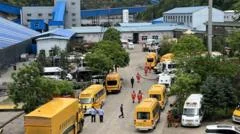
At least 82 people have been killed in a massive gas explosion at a coal mine in China’s northern Shanxi province, state media reported on Saturday. The blast, which ripped through the Liushenyu mine, marks the deadliest mining disaster the country has seen in 16 years — and has sent shockwaves through an industry already under intense scrutiny over safety failures.
For the families of the miners, the news is devastating. For the nation, it is a grim reminder of the human cost of coal. The explosion, which occurred deep underground, has left rescue teams racing against time, though officials have confirmed that the death toll is unlikely to rise further as all missing workers have been accounted for.
What Happened at the Liushenyu Coal Mine
The explosion struck the Liushenyu coal mine in Shanxi province, a region that produces nearly a third of China’s coal. According to state media, a gas blast — likely caused by a buildup of methane — tore through the mine, trapping dozens of workers underground. Emergency crews were dispatched immediately, but the scale of the explosion made rescue efforts extremely difficult.
Initial reports from state-run news outlets confirmed at least 82 fatalities, with some sources later revising the number to 90. The exact figure remains under official verification, but what is clear is that this is the worst mining accident in China since 2010, when 133 miners died in a gas explosion in Henan province.
Why This Matters Right Now
This disaster is not just a tragedy — it is a test of China’s commitment to mining safety. For years, the government has promised stricter regulations, better enforcement, and a shift toward cleaner energy. Yet, coal remains the backbone of China’s economy, powering factories, homes, and industries. Every year, hundreds of miners lose their lives in preventable accidents.
For the families of the victims, the loss is personal and permanent. For the broader public, it raises uncomfortable questions: Are safety standards being ignored in the rush to meet energy demands? And how many more lives will be lost before real change happens?
How the Disaster Unfolded
The explosion occurred on the morning of May 23, 2026, at the Liushenyu mine, located in the city of Linfen, Shanxi. Witnesses reported hearing a loud blast followed by thick smoke billowing from the mine entrance. Rescue teams, including specialized mine rescue units, were deployed within hours.
State media initially reported that dozens of miners were trapped. As rescue operations progressed, the death toll climbed steadily. By late afternoon, officials confirmed that at least 82 bodies had been recovered. The mine was immediately shut down, and an investigation into the cause of the explosion has been launched.
Who Is Affected and What Officials Are Saying
The victims are primarily local miners, many of whom worked for state-owned or private mining companies in Shanxi. The region is known for its rich coal deposits, but also for a history of mining accidents. Families of the deceased have gathered near the mine site, waiting for news and demanding answers.
Chinese officials have expressed condolences and promised a thorough investigation. “We are deeply saddened by this tragedy,” a spokesperson for the Shanxi provincial government said. “All resources are being mobilized to support the families and to ensure that those responsible are held accountable.” However, no details have been released about potential negligence or safety violations.
What We Know So Far — and What Remains Unclear
What we know:
- A gas explosion occurred at the Liushenyu coal mine in Shanxi.
- At least 82 people have been confirmed dead.
- This is the worst mining disaster in China in 16 years.
- Rescue operations have concluded, with all missing workers accounted for.
What remains unclear:
- The exact cause of the gas buildup that led to the explosion.
- Whether safety protocols were followed or ignored.
- The full extent of any negligence or regulatory failure.
- Whether the death toll may be revised upward.
Risks, Concerns, and the Balanced View
Mining disasters in China are not new, but each one reignites debate about the balance between economic output and worker safety. Critics argue that despite repeated promises, enforcement of safety regulations remains weak, especially in smaller, privately-owned mines. Supporters of the industry point out that China has made significant progress in reducing mining fatalities over the past two decades, with annual deaths dropping from over 6,000 in the early 2000s to under 1,000 in recent years.
Still, the Liushenyu disaster shows that the risks remain very real. Methane explosions are a known hazard in coal mining, and proper ventilation, monitoring, and emergency protocols are supposed to prevent them. When they fail, the consequences are catastrophic.
“This is a stark reminder that coal mining remains one of the most dangerous jobs in the world, especially when safety is compromised for profit.” — Mining safety expert, speaking to local media
Why Similar Trends Are Growing
China’s reliance on coal is not diminishing. Despite ambitious goals for renewable energy, coal still accounts for nearly 60% of the country’s electricity generation. As energy demand grows, so does the pressure on mines to produce more, faster. This can lead to corners being cut, safety checks being skipped, and workers being put at risk.
The Liushenyu explosion is part of a broader pattern. In 2025, a coal mine accident in Guizhou killed 14 people. In 2024, a gas blast in Xinjiang left 21 dead. Each incident is met with promises of reform, but the underlying pressures remain unchanged.
What Readers, Workers, and Investors Should Know Now
For workers in China’s coal industry, this disaster is a chilling reminder of the dangers they face every day. Safety advocates are calling for independent inspections, stronger whistleblower protections, and greater transparency from mining companies.
For investors and companies involved in the coal supply chain, the disaster could lead to tighter regulations, temporary mine closures, and increased scrutiny. Shares of some coal mining companies may face short-term volatility as the market reacts to the news.
For the general public, this tragedy underscores the human cost of energy. Every time we flip a switch or charge a device, it is worth remembering the lives that are sometimes lost to power our world.
What Could Happen Next
An official investigation is underway, and its findings will be closely watched. If negligence is found, mine operators could face criminal charges, fines, and license revocations. The government may also announce new safety measures, though critics argue that enforcement — not regulation — is the real issue.
In the longer term, this disaster could accelerate China’s push toward cleaner energy sources, as public pressure mounts to reduce the human toll of coal mining. However, given the country’s massive energy needs, coal is unlikely to be phased out anytime soon.
Our Take: Why This Story Matters Beyond One Incident
The Liushenyu mine explosion is not just a statistic — it is a human tragedy that reflects deeper systemic problems. It is about the lives of ordinary workers, the families left behind, and the difficult choices that countries make between economic growth and human safety.
This story matters because it asks us to look beyond the headlines and remember that behind every number is a person. It also reminds us that the energy we consume has a cost — and sometimes, that cost is measured in lives.
FAQs
What caused the coal mine explosion in Shanxi, China?
The explosion was caused by a gas buildup, likely methane, which ignited deep inside the Liushenyu coal mine. The exact source of ignition is still under investigation.
How many people died in the Chinese coal mine explosion?
At least 82 people were killed in the blast, making it the deadliest mining disaster in China in 16 years. Some reports have suggested the toll could be as high as 90.
Is this the worst mining disaster in China’s history?
No, but it is the worst in 16 years. The deadliest mining disaster in modern Chinese history occurred in 2010, when 133 miners died in a gas explosion in Henan province.
What safety measures are in place for Chinese coal mines?
Chinese law requires coal mines to have ventilation systems, gas monitoring equipment, and emergency protocols. However, enforcement is inconsistent, and smaller or private mines often face less oversight, leading to higher risks.