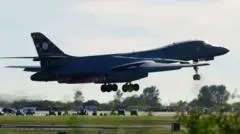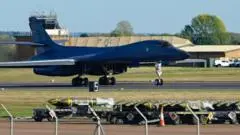


The Pentagon confirmed on Sunday that B1 bombers stationed at RAF Fairford in England have been pulled out and returned to their home stations in the United States. The decision, according to President Trump, was driven by a "threat" — though what that threat entailed has not been publicly detailed.
What the Pentagon Confirmed — and What It Didn't
The confirmation came directly from the Pentagon on Sunday, stating the B1 bombers had been removed from the base and sent back to their home stations in America. No further operational details were provided in the immediate statement.
RAF Fairford, a Royal Air Force base in Gloucestershire, has long hosted US bomber deployments. The sudden removal of the B1s marks a notable shift in the visible US military footprint at the site.
Why a Bomber Withdrawal From a NATO Ally's Soil Draws Attention
US strategic bombers stationed in Europe serve as both a deterrent and a signal of commitment to NATO allies. Their presence at RAF Fairford is typically part of scheduled rotations or exercises.
When those aircraft leave earlier than expected — or under circumstances described as threat-driven — it raises immediate questions about what changed in the security picture.
Trump's 'Threat' Comment: What We Know
President Trump said a "threat" led to the decision. He did not specify the nature of the threat, nor did he indicate whether it was directed at the base, the aircraft, or was part of a broader strategic calculation.
Without further detail from the White House or Pentagon, the exact rationale remains unclear. Officials have not elaborated beyond the initial confirmation.
Who Is Affected by This Move
For local communities around RAF Fairford, the departure of US bombers is a visible change. The base has been a fixture of the area, and deployments often bring economic activity and public attention.
For NATO allies and military planners, the withdrawal removes a tangible US bomber presence from European soil — at least temporarily. Whether that gap is filled by other assets or rotations is not yet known.
What Officials Have Said — and What Remains Open
The Pentagon's confirmation was brief: the bombers were removed and returned to home stations. President Trump's "threat" comment is the only stated reason so far.
There has been no public explanation of what the threat was, whether it was imminent, or whether it has been resolved. No timeline for a possible return of the bombers has been given.
Confirmed Facts vs. What Remains Unclear
Confirmed: The Pentagon said on Sunday that B1 bombers were pulled from RAF Fairford and returned to their home stations in the US. President Trump said a "threat" led to the decision.
Unclear: The specific nature of the threat, whether it was directed at the base or personnel, whether the withdrawal is permanent or temporary, and what impact this has on broader US military posture in Europe.
Any speculation beyond these confirmed points should be treated as just that — speculation.
Risks and Balanced View
Withdrawing strategic assets from a forward location can be read in multiple ways. It could signal a specific, credible threat that prompted a precautionary move. It could also be part of a routine re-posture that was described in stark terms.
Without additional information, it is difficult to assess whether this is a routine operational decision or something more significant. Both possibilities remain open.
Wider Pattern: US Bomber Deployments in Europe
US bomber rotations through RAF Fairford and other European bases have been a regular feature of NATO posture, particularly in recent years. These deployments are often planned in advance and publicly announced.
An unplanned or threat-driven withdrawal is less common and therefore draws more scrutiny. It remains to be seen whether this is an isolated event or part of a larger shift.
What Readers Should Watch For
Further statements from the Pentagon or White House clarifying the nature of the threat. Any announcement about whether the bombers will return to RAF Fairford or be replaced by other assets. And any reaction from NATO or UK officials.
Until then, the core facts remain: the bombers left, the Pentagon confirmed it, and Trump cited a "threat" without elaboration.
Future Outlook
If the threat was specific and time-bound, the bombers could return once it is addressed. If it reflects a broader reassessment, the withdrawal could be longer-lasting.
No official timeline has been provided. The situation remains fluid, and further details may emerge in the coming days.
Our Take
This is a story defined as much by what we don't know as by what we do. The Pentagon confirmed the withdrawal. Trump cited a threat. Beyond that, the public picture is incomplete.
What matters now is whether officials provide clarity — or whether the absence of detail itself becomes the story. For now, the bombers are gone from RAF Fairford, and the reason remains as vague as the word "threat" itself.
Frequently Asked Questions
What happened at RAF Fairford?
The Pentagon confirmed on Sunday that B1 bombers were removed from RAF Fairford in England and returned to their home stations in the United States.
Why were the bombers pulled out?
President Trump said a "threat" led to the decision. The specific nature of that threat has not been publicly detailed by the White House or Pentagon.
Is this a permanent withdrawal?
It is not yet clear. No timeline has been given for whether or when the bombers might return to RAF Fairford.
What does this mean for US military presence in Europe?
The withdrawal removes a visible US strategic bomber presence from a NATO ally's territory, at least temporarily. Whether this signals a broader shift remains unknown.