
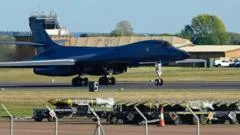
The tarmac at RAF Fairford is quieter than it has been in weeks. According to a statement, every US bomber deployed to the British base has now been "re-deployed to their home stations" in the United States — ending a visible American bomber presence on British soil.
What the US Air Force Actually Said About RAF Fairford
The statement is short and specific: all bombers sent to RAF Fairford have returned to their home stations in the US. It does not name the aircraft, the units involved, or the number of planes that left.
What it does confirm is that the deployment is over. RAF Fairford, a base in Gloucestershire long associated with American bomber operations, is no longer hosting that forward-deployed force.
Why a Bomber Pullout From Britain Draws Attention
RAF Fairford is not an ordinary airfield. It has served as a forward operating location for US long-range strike aircraft, which is why movements there are watched closely by defence analysts and aviation observers alike.
When bombers arrive, it is usually read as a signal of presence and reach. When they leave, the same logic applies in reverse — even when no official explanation is offered.
How the Deployment Unfolded
Based on the statement alone, the sequence is straightforward: bombers were deployed to RAF Fairford, and they have now been re-deployed to their home stations in the US.
No timeline was given for when the aircraft arrived or when they departed. No reason was stated for the withdrawal.
Who Feels the Change — Locals, Spotters and Allies
For residents around Fairford, the arrival and departure of American bombers is a familiar rhythm — louder skies, more traffic, and a visible reminder of the base's role.
For aviation enthusiasts and defence watchers, the pullout removes a key point of interest. For Britain's allies in Europe, it removes a visible American strike presence from a British airfield, at least for now.
The Official Line — and What It Leaves Out
The statement is factual and narrow. It confirms the re-deployment but offers no context on why it happened or what it means.
That silence is itself notable. In defence matters, what is not said often carries as much weight as what is.
Reading the Signal Behind the Withdrawal
Bomber deployments are routinely described as rotational and temporary. A return to home stations is consistent with that framing.
But without an official explanation, it is not possible to say whether this reflects a scheduled end to a rotation, a change in operational priorities, or something else. Any interpretation beyond the statement is speculation.
Confirmed Facts vs What Remains Unclear
Confirmed: All bombers deployed to RAF Fairford have been re-deployed to their home stations in the US, according to the statement.
Unclear: The reason for the withdrawal, the number and type of aircraft involved, the timing, and whether new deployments are planned. None of this was addressed in the source material.
Risks and the Balanced View
It would be easy to read the pullout as a downgrade of the US presence in Britain. That conclusion is not supported by the statement.
Equally, it would be wrong to assume the move is routine without evidence. The honest position is that the withdrawal is confirmed, and its significance is not yet clear.
The Wider Pattern of US Bomber Rotations
American bomber aircraft have periodically operated from RAF Fairford as part of broader rotational deployments. Such movements are typically temporary by design.
Seen in that light, a return to home stations fits an established pattern — though the absence of detail makes it difficult to place this specific pullout within it.
What This Means for Readers Following the Story
For now, the practical takeaway is simple: the bombers have gone, and the base's bomber presence has ended according to the official statement.
Anyone tracking the story should watch for follow-up statements from US or UK defence officials, which may clarify the reason and any future plans.
What Could Happen Next
Two outcomes are plausible. Either the withdrawal is the end of a routine rotation, or it precedes a new deployment cycle later.
Neither can be confirmed from the available statement. Until officials say more, the only verified fact is that the bombers have left RAF Fairford.
Our Take
This is a story defined by what is confirmed and what is missing. The confirmed part is small but concrete: the bombers are gone. The missing part — the why — is what will keep the story alive.
For readers, the lesson is to hold the line between fact and inference. A withdrawal is a fact. Its meaning is still an open question.
Frequently Asked Questions
Have all US bombers left RAF Fairford?
Yes. According to the statement, all bombers deployed to RAF Fairford have been re-deployed to their home stations in the US.
Why were the bombers removed from RAF Fairford?
No reason was given in the statement. The withdrawal was confirmed, but the explanation was not provided.
Where have the bombers gone?
The statement says they were re-deployed to their home stations in the United States.
Will US bombers return to RAF Fairford?
That is not clear. No future deployment plans were mentioned in the available statement.