For most people, ChatGPT still lives in a single browser tab. One person, one chat, one problem at a time. That model is now being pushed aside. OpenAI is building something called ChatGPT Space — a shared hub where work projects and personal AI agents sit together, and where ChatGPT is also headed into Slack and Microsoft Teams.
If it works the way the report describes, the assistant stops being a personal tool and becomes part of the office itself.
What ChatGPT Space Actually Changes
The core idea is simple to state and hard to build: instead of every employee running their own private ChatGPT threads, a team gets one shared space. Projects live there. So do the AI agents people have set up for themselves.
That means a colleague's agent — the one trained on your sales data, or your codebase, or your support tickets — could sit next to yours in the same workspace rather than disappearing into someone's personal account.
Why Slack and Teams Matter More Than the Hub Itself
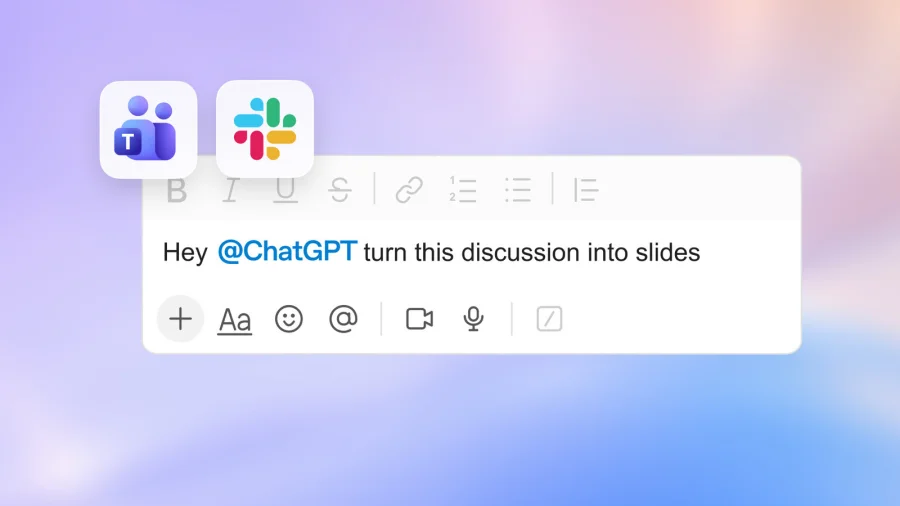
The Slack and Microsoft Teams part of this story is arguably the bigger shift. Those two platforms are where work conversations already happen for millions of teams.
Putting ChatGPT inside them removes the single biggest friction point in workplace AI adoption: switching apps. You would not open a separate tool. You would ask inside the thread you were already reading.
How We Got Here
ChatGPT began as a consumer product built around individual conversations. Over time, OpenAI added team and enterprise tiers, shared workspaces and custom assistants — each step nudging the product from personal curiosity toward workplace infrastructure.
ChatGPT Space, as described, looks like the next step in that same direction. The original report does not specify a launch date, pricing, or which plan tiers would get access first.
Who Feels This First
Knowledge workers in mid-sized and large companies are the obvious first audience — the people already juggling Slack channels, Teams calls and a dozen browser tabs.
Smaller teams may feel it differently. For a five-person startup, a shared AI hub could replace tools they were paying for separately. For a large enterprise, the harder questions are about permissions, data boundaries and who can see whose agent.
What Has Been Confirmed — and What Has Not
Confirmed by the report: ChatGPT Space is positioned as a shared hub for work projects and personal AI agents, and ChatGPT is coming to Slack and Microsoft Teams.
Not confirmed: launch timelines, pricing, enterprise data controls, whether personal agents remain private by default, and how the Slack and Teams integrations will actually be scoped. Any specifics beyond the headline should be treated as unverified until OpenAI publishes details.
The Real Differentiator Is Distribution, Not Features
Competitors have shipped AI assistants inside chat platforms before. What OpenAI brings is scale — ChatGPT already has an enormous user base that uses it daily for work, often without official approval from IT departments.
Meeting those users inside Slack and Teams converts quiet, unsanctioned usage into something a company can actually manage. That distribution advantage is harder to copy than any single feature.
The Risks Worth Watching
Shared AI workspaces raise uncomfortable questions. If agents sit in a common hub, what stops one team's data from leaking into another's context? Who audits what an agent was told?
There is also a competitive risk for OpenAI itself. Slack is owned by Salesforce and Teams by Microsoft — both companies have their own AI assistants. Being a guest inside a rival's platform is a position with limited control.
The Bigger Pattern: AI Moving Into the Room
Across the industry, AI is migrating out of standalone chat windows and into the tools where work already happens — email, documents, chat, code editors.
ChatGPT Space fits that pattern. The question is no longer whether AI will sit inside your workflow. It is who owns the layer it sits on.
What Teams Should Do Right Now
Nothing urgent — but this is a good moment to get your house in order. Know which employees are already pasting company data into AI tools. Decide who would be allowed to build a shared agent, and what it could access.
Teams that sort out those rules before the feature arrives will adopt it faster. Teams that don't will spend the first month firefighting.
What Happens Next
Expect OpenAI to publish specifics on availability, admin controls and pricing before any broad rollout. Watch for how the Slack and Teams integrations handle permissions — that detail will decide whether enterprises trust it.
Until then, treat ChatGPT Space as a clear signal of direction rather than a finished product.
Our Take
The interesting part of this story is not the hub. It is the admission that AI's future at work is collaborative, not individual. A personal chatbot was always a transitional form. The moment assistants need shared context, shared memory and shared rules, they stop being apps and start being infrastructure.
ChatGPT Space, if it ships as described, is OpenAI's bid to own that infrastructure — inside someone else's office, on someone else's chat platform.
Frequently Asked Questions
What is ChatGPT Space?
ChatGPT Space is described as a shared hub where teams can organise work projects and personal AI agents in one place, rather than each person running isolated ChatGPT conversations.
Is ChatGPT coming to Slack and Microsoft Teams?
Yes, according to the original report. ChatGPT is expected to be available inside both Slack and Microsoft Teams, putting the assistant directly into existing workplace conversations.
When will ChatGPT Space launch?
No launch date has been confirmed. Details on timing, pricing and which plans get access first have not been officially published.
How is this different from using ChatGPT at work today?
Today, most workplace ChatGPT use is individual and often unsanctioned. A shared hub would let teams manage projects and agents together, with visibility that individual accounts do not provide.