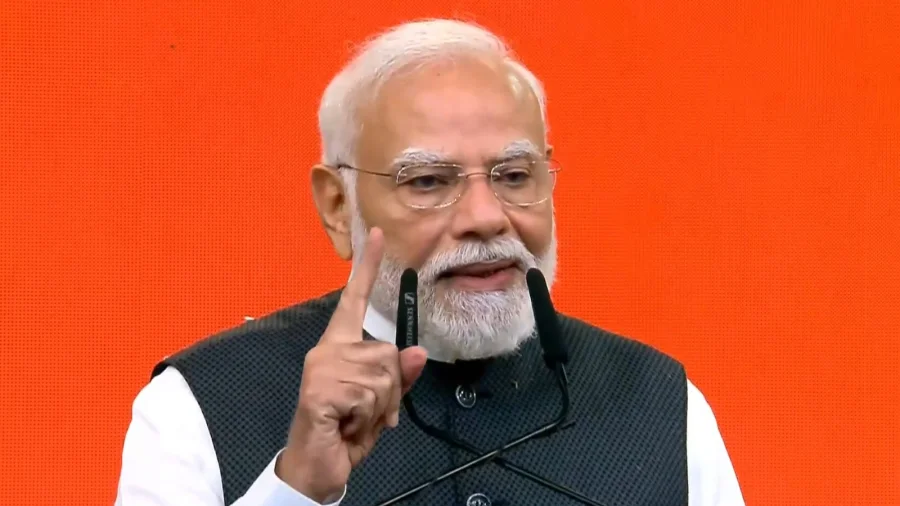
Twenty-five years is long enough to forget the fear of a first crisis. For Prime Minister Narendra Modi, it has been long enough to remember every one of them — and to draw a single, stubborn lesson from each. Marking 25 years in public service, he returned to that lesson: when the moment demands it, India says "we will do it."
The phrase is not new to his speeches. What is new is the framing — a self-confidence mantra, offered not as a slogan but as the operating principle behind the Viksit Bharat 2047 goal.
From Bhuj to Covid: The Crises That Shaped the Message
PM Modi traced the arc of his public life through two very different emergencies. The 2001 Bhuj earthquake, which struck while he was Chief Minister of Gujarat, and the Covid-19 pandemic, which tested his government on a national and global scale.
Both, in his telling, were moments when certainty was scarce and decisions had to be made anyway. The lesson he drew was less about policy and more about temperament — the willingness to act before the outcome is guaranteed.
Why the 2047 Deadline Carries Weight
Viksit Bharat 2047 is timed to the centenary of India's independence. That makes it more than a development target; it is a generational promise with a fixed date attached.
For ordinary citizens, the framing matters because it shifts the conversation from annual budgets to a 22-year horizon — education, jobs, infrastructure, and global standing all folded into one long arc.
How the Message Has Evolved Over 25 Years
The Bhuj earthquake response became an early defining chapter of Modi's tenure in Gujarat. Two decades later, the pandemic tested a very different kind of leadership — one managing supply chains, vaccines, and a nationwide lockdown.
Between those two moments sit two decades of state and central governance. The PM's reflection treats them as a continuous education rather than separate chapters.
Who This Message Is Really Aimed At
Reflective speeches of this kind are rarely aimed at the present. They are aimed at the next decade — at young Indians who will be in their thirties and forties when 2047 arrives.
For students, first-time voters, and young professionals, the appeal is aspirational: a promise that the country's trajectory is upward, and that their own timelines are tied to it.
What the PM Actually Said — and What He Didn't
The remarks were reflective in nature, drawing on personal experience rather than announcing new schemes or targets. No fresh policy measures were outlined in the message as reported.
That distinction matters. A mantra is not a manifesto. It sets tone and intent, while the specifics remain with ministries, states, and the budget cycle.
Confirmed Facts vs What Remains Unclear
Confirmed: PM Modi marked 25 years in public service and referenced the Bhuj earthquake and Covid-19 pandemic as key learning experiences. He framed "we will do it" as a self-confidence mantra tied to Viksit Bharat 2047.
Unclear: The specific policy roadmap, measurable milestones, or institutional mechanisms that will define the 2047 goal have not been detailed in this particular message. Any interpretation of new commitments would be speculation.
The Political Reading: Confidence as Strategy
Self-confidence, as a political message, does two things at once. It reassures supporters that the direction is right, and it pre-empts doubt by framing hesitation itself as the obstacle.
Critics, however, are likely to ask whether confidence alone can substitute for measurable delivery on jobs, inflation, and public services — questions that will define the political conversation regardless of the mantra.
A Pattern Across Recent Government Messaging
Viksit Bharat 2047 has become a recurring anchor in the government's long-term communication — appearing in speeches, official campaigns, and youth outreach.
The repetition is deliberate. Long-horizon goals require sustained narrative, not a single announcement, to stay alive in public memory.
What This Means for Ordinary Indians
For most people, the practical takeaway is not a scheme or a deadline to act on. It is a signal about the government's stated direction over the next two decades.
Readers tracking education, employment, or infrastructure policy should watch for concrete follow-ups — budget allocations, mission documents, and state-level plans — rather than the mantra itself.
What Could Come Next
Expect the Viksit Bharat 2047 theme to continue featuring in national addresses, youth events, and international forums. Specific deliverables, if any, would likely surface through formal policy channels.
Whether the mantra translates into measurable outcomes will depend on execution — the part that no speech can guarantee.
Our Take
The "we will do it" framing is effective precisely because it is simple. It converts a complex, multi-decade national project into a single act of collective will.
But mantras are judged by what follows them. The real test of Viksit Bharat 2047 will not be the confidence of the message — it will be the credibility of the delivery.
Frequently Asked Questions
What did PM Modi say about Viksit Bharat 2047?
Marking 25 years in public service, PM Modi framed "we will do it" as a self-confidence mantra for achieving a developed India by 2047, drawing lessons from crises like the Bhuj earthquake and Covid-19.
Why did PM Modi mention the Bhuj earthquake and Covid-19?
He cited them as defining moments that taught him to act decisively under uncertainty — lessons he linked to the long-term national goal.
Is Viksit Bharat 2047 a new scheme or policy?
No. It is a long-term vision tied to India's centenary of independence. The recent remarks were reflective and did not announce new schemes.
What should citizens watch for next?
Concrete follow-ups such as budget allocations, mission documents, and state-level plans — these will indicate how the 2047 vision translates into action.