
Some chases are won by calculation. This one was won by demolition. India walked into Guwahati needing 406 to beat West Indies — a total that would have broken most teams — and walked off with eight wickets still standing and 39 balls to spare. By the time the winning runs came, the target no longer looked like a mountain. It looked like a formality.
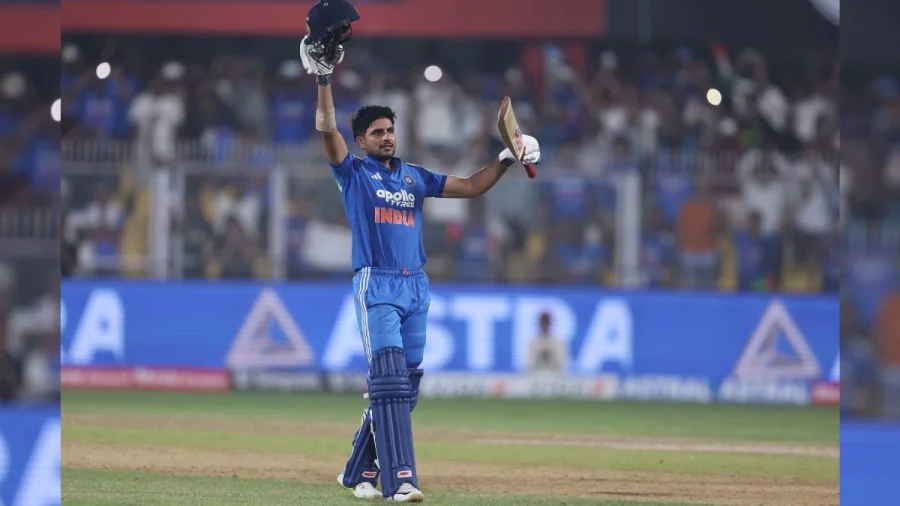
At the centre of it all was captain Shubman Gill, unbeaten on 223 off just 133 balls, an innings that turned a difficult chase into a statement of intent.
Gill's 117-Ball Double Century Sets the Tone for India's Chase
Gill's knock was the spine of the innings. He reached his double hundred off just 117 deliveries — the fastest in ODI history — and never slowed down. Boundaries came in clusters, singles were rotated without fuss, and the required rate, which started steep, kept sliding.
What stood out was the calm. There was no panic, no wild slogging, no sense that India were chasing a record. Gill simply kept finding the gaps, and West Indies had no answer.
Rohit Sharma's 101 Off 75 Gives India a Platform to Attack
At the other end, Rohit Sharma made 101 off 75 balls, an innings that set the tone before Gill took over. The two put on 255 for the opening wicket from just 158 deliveries — a partnership that effectively killed the contest before the halfway mark of the chase.
Rohit's approach was familiar: take on the new ball, target the powerplay, and let the innings breathe. By the time he fell, India were already ahead of the required rate.
Why 406 in 43.3 Overs Matters Beyond the Scoreboard
Chasing 406 is rare. Doing it in 43.3 overs is rarer still. For context, most successful 400-plus chases in ODI history have gone deep into the final over. India finished with more than six overs to spare.
That margin matters. It signals that this was not a lucky chase built on one freak innings — it was a controlled, clinical dismantling of a bowling attack that had no answer to India's top order.
How the Series Was Won Before the Final ODI
The win in Guwahati gave India an unassailable 2-0 lead in the three-match series, sealing the trophy with one game still to play. The first ODI had already put India ahead; this one removed any doubt.
For West Indies, the tour now becomes about damage limitation. For India, it becomes about managing workloads and giving fringe players a look-in during the dead rubber.
What This Means for India's ODI Blueprint
India's top order has been under scrutiny in recent months, with questions about strike rates, intent, and consistency in 50-over cricket. A 406 chase, completed with eight wickets in hand, answers most of those questions in one evening.
Gill's captaincy, meanwhile, is beginning to carry a distinct identity — aggressive, unafraid of big targets, and willing to back his batters to outscore opponents rather than contain them.
Confirmed Facts vs What Remains Unclear
Confirmed: India chased 406 in 43.3 overs, won by eight wickets, took a 2-0 series lead. Gill made 223* off 133; Rohit made 101 off 75. The opening stand was 255 off 158 balls. Gill's double century came off 117 balls.
Unclear or unverified: Full bowling figures, exact fall-of-wickets details, and post-match comments from both captains were not available in the source material. Any claims about records beyond the fastest ODI double century should be treated as unconfirmed until official scorecards are reviewed.
Risks and the Balanced View
One spectacular chase does not erase every concern. India's bowling attack conceded 405, and on a flat Guwahati surface, the margin between victory and defeat was always going to be decided by the batters. Against stronger bowling line-ups on more demanding pitches, the same approach may not always work.
There is also the question of workload. Gill batted 133 balls in a chase; Rohit faced 75. Managing that intensity across formats will be a challenge for the team management.
The Wider Pattern: ODI Cricket Is Changing
Chases of 350-plus are no longer rare. 400 is no longer safe. The 2023 World Cup showed that modern ODI batting has shifted decisively toward aggression, and India's performance in Guwahati is the latest data point in that trend.
Bowlers, across teams, are being asked to defend totals that would have been match-winning a decade ago. The game is tilting further toward the bat.
What Readers and Fans Should Take Away
For fans, this was a reminder of why ODI cricket still produces the most dramatic finishes in the sport. For analysts, it is a case study in how a top order can absorb pressure and convert a difficult chase into a routine one.
For young cricketers watching, the lesson is simple: big targets are chaseable if the first 15 overs are used well.
What Comes Next for India and West Indies
The third ODI remains, though the series is already decided. India may look to rotate the squad, while West Indies will be playing for pride and a consolation win.
Beyond this series, India's focus will shift to the next international assignment, where the same top order will be tested in different conditions.
Our Take
This was not just a win. It was a statement about how India want to play ODI cricket under Shubman Gill — fearless, fast, and unbothered by big totals. Whether that approach holds up in tougher conditions is the real question. But for one night in Guwahati, it looked unstoppable.
Frequently Asked Questions
What was the target India chased against West Indies in Guwahati?
India chased 406 against West Indies, reaching the target in 43.3 overs with eight wickets in hand.
How many runs did Shubman Gill score in the Guwahati ODI?
Shubman Gill scored an unbeaten 223 off 133 balls, including the fastest ODI double century off just 117 deliveries.
Did India win the ODI series against West Indies?
Yes. The win in Guwahati gave India an unassailable 2-0 lead in the three-match series, sealing the trophy with one game remaining.
How many runs did Rohit Sharma score in the chase?
Rohit Sharma scored 101 off 75 balls, sharing a 255-run opening partnership with Shubman Gill that came from just 158 deliveries.