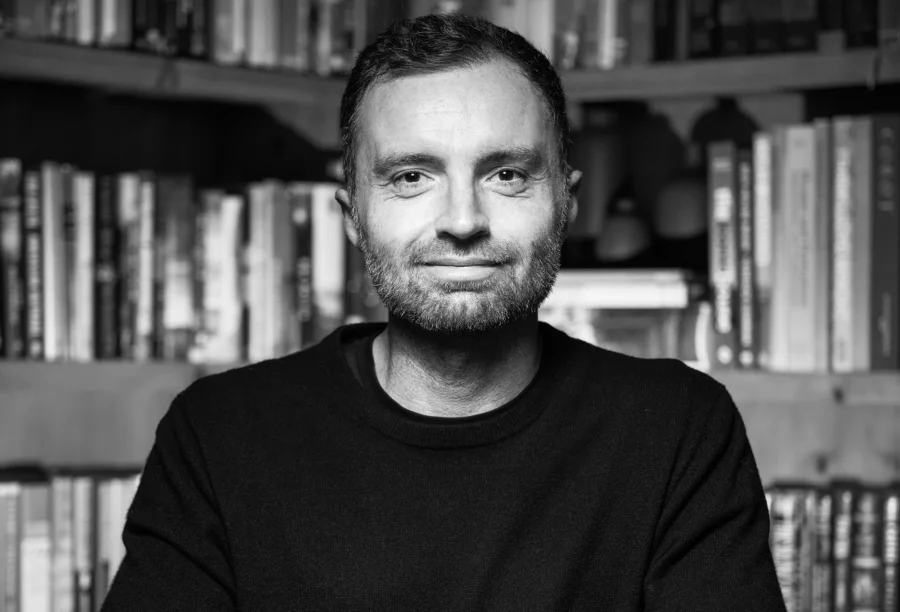
For five and a half years after he launched Founders in 2016, almost nobody listened. David Senra read one business biography per week—hard copy, with a pen and a six-inch ruler and a stack of Post-its—photographed his annotations, recorded his thoughts alone in a room, and published the result. No audience. No income. No feedback worth mentioning.
"I told everyone, from day one, even with a single listener, that I was going to do this whether anybody listened or not," he told Fortune over FaceTime.
The proof is in the RSS feed. Hidden inside the code for Founders is a single line still bearing the podcast's original title: "Autotelic"—a word that means an activity done purely for its own sake.
The obsession that built a CEO fanbase
Senra's method is almost monastic. Every week, he selects one business biography—often about iconic entrepreneurs like Steve Jobs, Walt Disney, or Estée Lauder—and reads it cover to cover with a physical book. He marks passages with Post-its, writes notes in the margins with a pen, and uses a six-inch ruler to keep his place. Then he photographs his annotations and records a solo episode distilling the lessons.
There are no guests. No interviews. No news segments. Just one man and a book.
That purity is exactly what attracted the world's most powerful CEOs. Jeff Bezos has publicly recommended Founders. Michael Dell is a known listener. Coinbase CEO Brian Armstrong and Ramp CEO Eric Glyman have also cited it as a key influence.
Why CEOs can't stop listening
For executives running billion-dollar companies, time is the scarcest resource. Founders offers a shortcut: Senra does the reading, extracts the most valuable lessons from the lives of history's greatest entrepreneurs, and delivers them in concentrated form.
"He's not trying to entertain you. He's trying to teach you," one Silicon Valley investor told Fortune. "That's why CEOs trust it."
The podcast's structure mirrors the obsessive nature of its subjects. Senra doesn't summarize—he immerses. Episodes often run 60 to 90 minutes, dense with original quotes, historical context, and Senra's own reflections on what made each founder tick.
The $50 million offer he turned down
As Founders grew, the offers came. One suitor proposed acquiring the podcast for $50 million—a life-changing sum for a creator who had spent years earning nothing.
Senra said no.
He told Fortune the offer would have required him to cede creative control and compromise the podcast's integrity. "Unmanageable" is how he described himself to potential acquirers. He wanted to build a media empire on his own terms, not sell out before the real work began.
The decision shocked many in the podcast industry, where acquisition exits are common. But for Senra, the "Autotelic" ethos—doing the work for its own sake—was never just a tagline.
How the audience finally found him
For years, Founders grew entirely by word of mouth. Senra did no advertising, no social media marketing, no guest appearances to promote the show. He simply kept publishing.
The turning point came when influential figures in tech and business began mentioning the podcast unprompted. Bezos's recommendation alone sent thousands of new listeners to the feed. From there, the network effect kicked in: CEOs told other CEOs, investors told founders, and Founders became a quiet phenomenon in the upper echelons of business.
Today, the podcast regularly tops charts in the business category and has spawned a loyal community of listeners who call themselves "founders."
Confirmed facts vs what remains unclear
Confirmed: Senra launched Founders in 2016. He spent 5.5 years with minimal audience. He reads one biography per week using physical books, a pen, a ruler, and Post-its. He records solo episodes. Jeff Bezos, Michael Dell, and Brian Armstrong are confirmed fans. He turned down a $50 million acquisition offer.
Unclear: The exact current listener count and revenue figures have not been publicly disclosed. The identity of the $50 million suitor has not been revealed. Senra's long-term plans for the "media empire" beyond the podcast remain unspecified.
Why this matters for creators and entrepreneurs
Senra's story is a counter-narrative to the dominant playbook for podcast success: launch fast, optimize for algorithms, chase guests with existing audiences, monetize early, sell out.
He did none of that. He built a product so good that the world's most discerning consumers—CEOs who could hire entire research teams—chose to listen instead.
For aspiring creators, the lesson is uncomfortable but clear: the path to building something that matters to powerful people may require years of obscurity, zero external validation, and a willingness to say no to life-changing money.
Risks and balanced view
Senra's approach is not replicable for everyone. Most creators cannot afford to work without income for years. The podcast industry is increasingly crowded, and the window for organic, word-of-mouth growth may be narrowing.
Critics might argue that Senra's success is partly a product of timing and luck—launching before the podcast boom, catching the attention of a few influential figures who amplified his work. Others point out that his model (solo, no guests, no ads for years) would struggle to gain traction in today's algorithm-driven discovery environment.
There is also the question of scale. Can Founders grow into a true media empire without compromising the very qualities that made it special? Senra's rejection of the $50 million offer suggests he is aware of this tension, but the challenge remains.
The wider trend: the rise of obsessive, niche content
Senra is part of a broader shift in media consumption. Audiences are increasingly rejecting generic, mass-market content in favor of deeply researched, passionately produced work from a single, trusted voice.
Podcasts like Founders, The Tim Ferriss Show, and Acquired have proven that long-form, niche content can attract not just large audiences, but the right audiences—people with influence, money, and decision-making power.
This trend has implications for advertisers, investors, and platforms. The most valuable media properties of the next decade may not be the ones with the most listeners, but the ones with the most devoted listeners.
What listeners and creators should learn
For listeners: Founders is a masterclass in how to learn from history's greatest entrepreneurs without spending hundreds of hours reading. Each episode is a concentrated dose of wisdom from figures who built empires, failed spectacularly, and tried again.
For creators: Senra's journey offers a brutal but inspiring template. Find a format you can sustain indefinitely. Focus on quality over growth. Ignore the noise. Be willing to work for years without recognition. And when the exit offers come, know what you're willing to sacrifice—and what you're not.
Future outlook
Senra has signaled he wants to expand Founders beyond the podcast into a broader media operation. What that looks like is unclear, but his track record suggests he will move slowly and deliberately, prioritizing substance over speed.
He has also hinted at potential live events, a book, or a paid membership community. Given his audience's demographics—high-income, highly influential professionals—any of these could be lucrative without requiring him to compromise.
The $50 million rejection was not a rejection of money. It was a rejection of a specific deal. Senra seems intent on building something worth far more—both financially and culturally—on his own terms.
Our Take
David Senra's story is not just about a podcast. It is about the power of doing something for its own sake long enough that the world eventually catches up.
In an era of content factories, algorithm optimization, and growth hacking, Senra built Founders the old-fashioned way: one book at a time, one episode at a time, one listener at a time. He treated his audience not as a metric to be grown, but as a community to be served.
The fact that Jeff Bezos and Michael Dell are among his listeners is almost incidental. The real story is that Senra never needed them to validate his work. He was going to do it anyway.
That is the "Autotelic" mindset. And it is why Founders will likely outlast the trends, platforms, and algorithms that define today's media landscape.
Frequently Asked Questions
What is the Founders podcast about?
Founders is a podcast where David Senra reads one business biography per week and records a solo episode distilling the most important lessons from the lives of history's greatest entrepreneurs. There are no guests or interviews—just Senra and the book.
How did David Senra get Jeff Bezos to listen to his podcast?
Senra did not pitch Bezos. Founders grew entirely by word of mouth over 5.5 years. Bezos discovered the podcast organically and began recommending it publicly, which drove massive growth.
Did David Senra really turn down $50 million?
Yes. Senra confirmed to Fortune that he rejected a $50 million acquisition offer for Founders because it would have required him to give up creative control. He described himself as "unmanageable" to potential acquirers.
How can I start a podcast like David Senra?
Senra's approach requires deep commitment to a specific format, willingness to work without audience or income for years, and a focus on quality over growth. His method: read one book per week, take physical notes, record solo, publish consistently, ignore metrics, and never compromise on substance.