
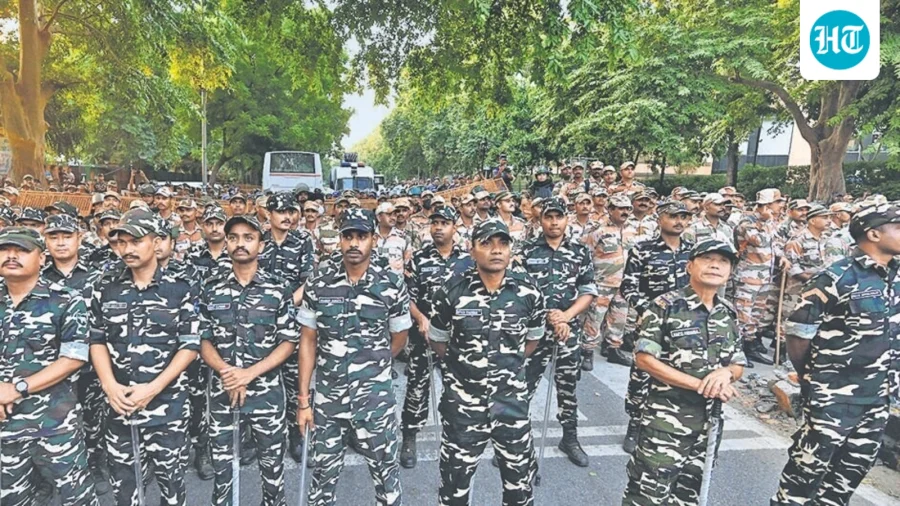
Delhi is waking up to a city under watch. With a CJP protest called for Saturday, the central armed police force deployment in the capital has been raised to around 26,000 personnel — a number that tells its own story about how seriously the day is being planned for.
For a city that has seen protests of every size and mood, 26,000 is not a routine figure. It is a signal.
The Number That Changes the Mood of the Capital
According to the original story, the additional deployment takes the total number of central force personnel in Delhi to roughly 26,000. That is the core fact — and it is enough to reshape how Saturday is being anticipated.
Central Armed Police Forces, or CAPFs, are the paramilitary units drawn from across India — the CRPF, BSF, ITBP, SSB, CISF and others. When they are moved into a city in these numbers, it usually means local police alone are not expected to be sufficient.
Why a Protest Number Matters to Ordinary Delhi
For residents, the impact is immediate and practical. Roads may be barricaded. Metro stations could see restrictions. Commutes, markets, and weekend plans may need to be rethought.
For the protesters themselves, the deployment raises a different question — how much space will be available for assembly, and under what conditions.
And for the city's administration, the calculation is delicate: enough force to prevent disorder, without turning a protest into a confrontation.
How Delhi Reaches a 26,000-Person Security Figure
Delhi does not deploy central forces casually. The process typically begins with a security assessment by Delhi Police, followed by a request to the Ministry of Home Affairs for central force companies.
Each company is roughly 100 personnel. A figure of 26,000 suggests a request in the range of 260 companies — a scale usually reserved for major events, elections, or high-risk law-and-order situations.
That the deployment has been raised, rather than simply maintained, suggests the assessment of Saturday's protest has been revised upward.
Who Feels This Deployment First
The first to feel it are usually commuters and residents near the protest route. Barricades go up before crowds arrive. Traffic diversions are announced. Metro entry and exit gates are selectively closed.
Then there are the protesters — many of whom may be travelling from outside Delhi. For them, the deployment is both a logistical hurdle and a signal about how the day is being viewed by authorities.
And finally, the personnel themselves. Thousands of CAPF jawans are being moved into the capital, often on short notice, for a single day of duty.
What Officials Have Said — and What Remains Unverified
At the time of writing, no detailed official statement on the deployment has been independently verified. The figure of around 26,000 comes from the original story and should be treated as the working number.
Readers should be cautious of unverified claims circulating on social media about specific routes, timings, or restrictions. Official Delhi Police and Metro advisories remain the most reliable source as Saturday approaches.
Confirmed Facts vs What Remains Unclear
Confirmed: The CAPF deployment in Delhi has been raised, taking the total to around 26,000 central force personnel. The build-up is linked to a CJP protest planned for Saturday.
Unclear: The exact protest route, expected crowd size, specific traffic and metro restrictions, and whether any Section 163 or similar prohibitory orders will apply. These details have not been verified at the time of writing.
The Pattern Behind Large Pre-Protest Deployments
Delhi has a long history of pre-emptive force build-ups before major protests — from farmer marches to student movements to political rallies. The pattern is consistent: numbers go up days in advance, advisories follow, and the actual day often unfolds differently from the worst-case planning.
What makes this deployment notable is the scale relative to a single-day event. A 26,000-strong central force presence is closer to what the capital sees during Republic Day or election counting — not a routine weekend protest.
What Delhi Residents Should Do Now
If you live, work, or plan to travel through central Delhi on Saturday, the practical steps are simple. Check Delhi Metro's official updates before leaving. Avoid the protest area unless you have a reason to be there. Keep buffer time for commutes.
If you are participating in the protest, carry ID, stay within announced routes, and follow instructions from police and organisers. Most confrontations begin with small, avoidable friction.
What Could Happen Next
The deployment could remain precautionary — a show of force that keeps the day peaceful without major incident. Or it could become operational, with restrictions, detentions, or dispersal actions.
Much depends on how the protest is conducted, how the police engage, and whether communication between organisers and authorities holds. None of that can be predicted with certainty.
Our Take
A 26,000-person central force deployment is not just a security number. It is a statement about how the state is reading Saturday — and a reminder that in Delhi, the space between a protest and a confrontation is often measured in how both sides handle the first few hours.
For now, the story is the build-up. By Saturday evening, it will be the outcome.
Frequently Asked Questions
How many CAPF personnel are being deployed in Delhi?
Around 26,000 central armed police force personnel, according to the original report. This includes the additional deployment made ahead of Saturday's CJP protest.
Why is the CAPF deployment being increased in Delhi?
The increase is linked to a CJP protest scheduled for Saturday. The additional forces are being positioned as a precautionary security measure.
Will metro services and roads be affected in Delhi on Saturday?
Restrictions are likely near the protest area, but specific advisories have not been independently verified at the time of writing. Check Delhi Metro and Delhi Traffic Police official updates before travelling.
What is CAPF and why is it deployed for protests?
CAPF stands for Central Armed Police Forces — paramilitary units like CRPF, BSF, and ITBP. They are deployed when local police are assessed to need additional strength for law-and-order situations.