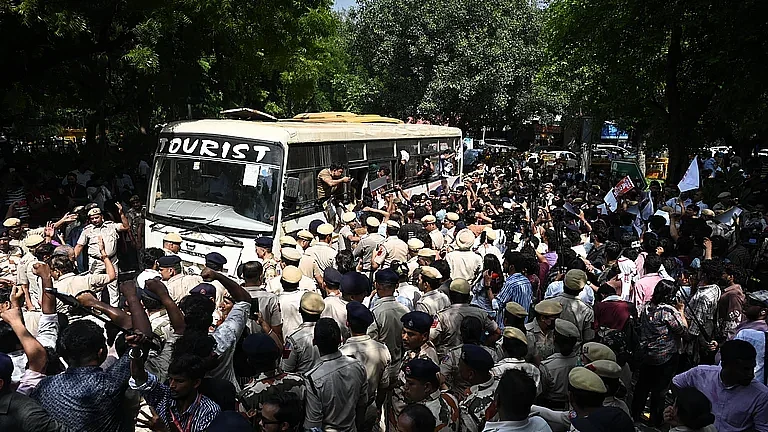
The barricades went up before sunrise. By mid-morning, they had been tested again. A day after Delhi Police detained more than 1,000 people across the capital, protesters returned to Jantar Mantar on Saturday — not to retreat, but to repeat a single demand: Chief Election Commissioner Gyanesh Kumar must resign.
For the young activists, students, and political workers who assembled near the capital's designated protest site, the message was clear. Detentions would not end the movement. They would only delay it.
A Second Day of Defiance at Delhi's Protest Ground
Saturday's gathering followed Friday's sweeping police action, when crowds were detained and dispersed across multiple locations in Delhi. Police said restrictions were in force and no permission had been granted for the demonstration.
On Saturday, the pattern repeated. Officers began detaining protesters early, asking crowds to disperse. Heavy security deployment and layered barricading turned the area around Jantar Mantar into a controlled zone. Yet protesters kept arriving in small groups, avoiding large formations that could be easily intercepted.
The demand remained unchanged: the resignation of Chief Election Commissioner Gyanesh Kumar.
Why the Demand for Gyanesh Kumar's Resignation Is Escalating
The protest is not a sudden eruption. It reflects a growing confrontation between sections of civil society and the Election Commission of India — an institution whose credibility is central to the country's democratic process.
For the protesters, the demand for the CEC's resignation is a question of accountability. For the authorities, the denial of permission is a question of law and order. Both sides are now locked in a standoff where neither appears willing to blink first.
The stakes extend beyond Delhi. If the protest sustains, it could become a national reference point for how dissent is managed in the capital — and how the Election Commission's leadership is perceived ahead of future electoral cycles.
From Friday's Crackdown to Saturday's Return: How the Standoff Unfolded
The sequence is now familiar. On Friday, protesters gathered in large numbers. Police moved in, detaining over 1,000 people. Crowds were asked to disperse. By evening, the streets were cleared — but the demand had not disappeared.
By Saturday morning, protesters were back. The Indian Youth Congress escalated the fight to the Delhi High Court, challenging the denial of protest permission. The Cockroach Janta Party, meanwhile, announced plans for a peaceful mobilisation on 10 October — signalling that the protest calendar is expanding, not shrinking.
Each development has added a new layer: police action, legal challenge, and a planned future mobilisation. The movement is no longer a single-day event. It is becoming a sustained campaign.
Who Is Affected — and Why This Matters Beyond Delhi
The immediate impact falls on those detained, their families, and the students and young workers who form the backbone of the protest. For them, the cost is personal — lost days, legal uncertainty, and the risk of police records.
But the wider impact touches every citizen who values the right to peaceful assembly. When protest permissions are denied and crowds are detained en masse, the question shifts from a specific demand to a broader principle: how does a democracy balance public order with political expression?
For the political opposition, the issue is mobilisation. For the government, it is containment. For the ordinary Delhi resident, it is the sight of barricades returning to a site that has historically hosted dissent.
Police, Courts, and Political Parties: The Institutional Response
Delhi Police have maintained that restrictions were in force and no permission was granted for Saturday's demonstration. Their position is procedural: without clearance, assembly is not permitted.
The Indian Youth Congress has taken the legal route, moving the Delhi High Court against the denial. That challenge will test whether the restriction on protest permission holds up to judicial scrutiny.
The Cockroach Janta Party's announcement of a peaceful mobilisation on 10 October adds a new dimension. It suggests that the protest is not solely tied to traditional political parties — newer, informal groups are also entering the fray.
Officials have not commented on the specific number of detentions on Saturday. The situation remains fluid.
What Is Confirmed — and What Remains Unclear
Confirmed: Over 1,000 people were detained across Delhi on Friday. Protesters returned to Jantar Mantar on Saturday. The Indian Youth Congress filed a challenge in Delhi High Court. The Cockroach Janta Party announced a 10 October mobilisation. Police cited lack of permission and restrictions.
Unclear: The exact number of detentions on Saturday. Whether the High Court will grant relief or direct the police to allow a future protest. Whether the 10 October mobilisation will receive permission. Whether the protest will spread to other cities.
Any claims about the protest's future size or the government's next move remain speculative at this stage.
The Right to Protest vs. Public Order: A Familiar Indian Dilemma
India's constitutional framework protects the right to peaceful assembly, but it also empowers authorities to impose reasonable restrictions. The tension between these two principles is not new — it has played out at Jantar Mantar, Ramlila Maidan, and Shaheen Bagh before.
What makes this moment distinct is the target: the Chief Election Commissioner. Protests against the Election Commission are rare and politically sensitive. They touch the machinery that conducts elections — an institution expected to remain above partisan conflict.
For the protesters, the demand is about restoring faith in that machinery. For the authorities, allowing the protest could set a precedent. Denying it could deepen the confrontation.
What This Means for the Broader Democratic Conversation
This is not just a Delhi story. It is a test case for how India handles dissent directed at constitutional bodies. The response — police action, court challenge, and planned future mobilisation — will be watched by civil society groups, political parties, and international observers.
If the protest sustains, it could reshape the political narrative around the Election Commission's leadership. If it fades, the demand may lose momentum. Either way, the next few weeks will be decisive.
What Should Citizens, Students, and Observers Do Now?
For those planning to join future protests, verify the legal status of any demonstration. Denied permission can lead to detention. Carry identification, inform family, and know your rights.
For students and young professionals, the legal challenge in Delhi High Court is worth following — it will clarify the boundaries of protest permission in the capital.
For observers, track official statements from Delhi Police and the Election Commission. Avoid relying on unverified social media claims about detention numbers or future plans.
What Could Happen Next
The Delhi High Court's response to the Indian Youth Congress plea will be the immediate trigger. If the court directs the police to allow a protest, the movement could gain legal legitimacy. If it upholds the denial, protesters may continue with civil disobedience-style gatherings.
The 10 October mobilisation announced by the Cockroach Janta Party is the next scheduled flashpoint. Whether it remains peaceful and whether police permit it will shape the narrative.
Beyond that, the demand for CEC Gyanesh Kumar's resignation is unlikely to disappear quickly. The protest has already survived one day of mass detentions. Its durability will now depend on organisation, legal strategy, and public sympathy.
Our Take
The return to Jantar Mantar after over 1,000 detentions is a signal. It tells authorities that the demand for CEC Gyanesh Kumar's resignation is not a one-day outburst. It also tells protesters that the state is willing to use mass detention as a deterrent.
What matters now is whether the confrontation remains peaceful and whether the courts provide a channel for resolution. A democracy is tested not by the absence of protest, but by how it manages dissent without eroding the right to express it.
This story is still developing. The next 48 hours — and the High Court's response — will determine whether Jantar Mantar becomes a sustained movement or a fading headline.
Frequently Asked Questions
Why are protesters demanding CEC Gyanesh Kumar's resignation?
Protesters are demanding the resignation of Chief Election Commissioner Gyanesh Kumar, though the specific grievances have not been detailed in available reports. The demand has become the central slogan of the Jantar Mantar protests.
How many people were detained in Delhi?
More than 1,000 people were detained across Delhi on Friday, according to police and protest reports. The exact number of detentions on Saturday has not been officially confirmed.
What is the Indian Youth Congress doing?
The Indian Youth Congress has challenged the denial of protest permission in the Delhi High Court. The legal challenge will test whether the restriction on the demonstration was justified.
What is the Cockroach Janta Party planning?
The Cockroach Janta Party has announced a peaceful mobilisation on 10 October. It is unclear whether police permission will be granted for that event.
Is the protest still ongoing?
Protesters returned to Jantar Mantar on Saturday despite heavy police deployment and barricading. The situation remains fluid, with detentions continuing and no permission granted for the demonstration.