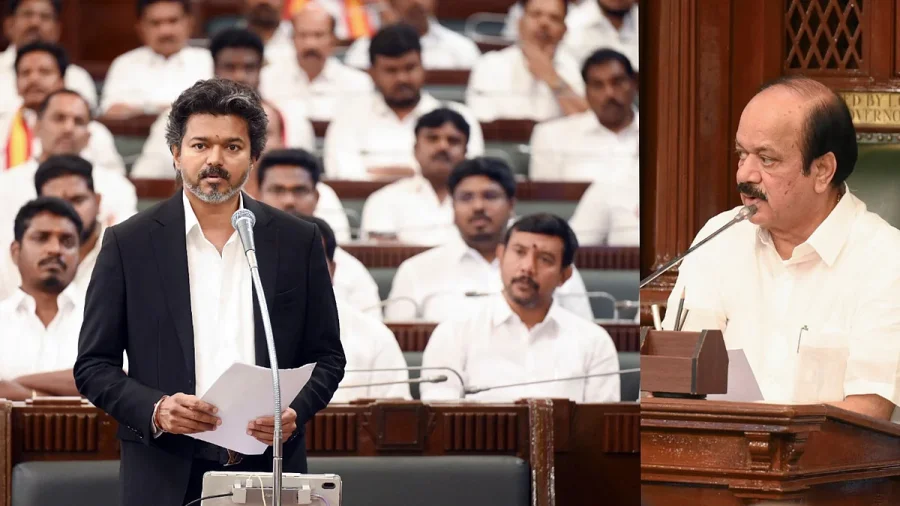
Tamil Nadu Chief Minister C. Joseph Vijay on Tuesday delivered a sharp rebuttal to the opposition DMK’s criticism of his party, Tamilaga Vettri Kazhagam (TVK), as inexperienced and an “actor’s party.” In a speech that blended defiance with a detailed account of his political journey, Vijay asserted that his leadership is built on decades of activism, not electoral shortcuts.
Decades of activism, not just cinema
Vijay traced his political roots to the 1990s, when he began organizing fan clubs that later evolved into a structured political movement. He argued that his experience in mobilizing people for social causes predates many of his critics’ own political careers. “We protect, we serve… we don’t loot,” he said, drawing a clear line between his party’s ethos and what he described as the DMK’s record.
Key movements that shaped his leadership
The CM highlighted his active participation in several landmark movements: the 2002 Sri Lankan Tamil crisis, where he advocated for the rights of Tamils in the island nation; the 2011 Nagapattinam fishermen protests against alleged Sri Lankan Navy aggression; the 2017 Jallikattu movement, which saw massive youth-led protests across Tamil Nadu; and his opposition to the Citizenship Amendment Act (CAA) in 2019. Each of these, he argued, demonstrates a consistent commitment to public service beyond electoral politics.
Why this matters for Tamil Nadu politics
The exchange is more than a personal spat. It reflects a deeper struggle for political legitimacy in a state where the DMK and AIADMK have dominated for decades. TVK, founded in 2024, is attempting to carve out a space as a third force. Vijay’s rebuttal is aimed at convincing voters that his party is not a celebrity vanity project but a serious political contender with grassroots credibility.
DMK’s criticism and the political context
The DMK had previously dismissed TVK as an “actor’s party,” questioning its readiness to govern. Vijay’s response was calibrated to turn that criticism into a strength, framing his cinematic career as a platform for public engagement rather than a liability. He also referenced overcoming significant personal and political challenges, though specific details were not elaborated upon in his address.
What remains unclear
While Vijay has laid out his activist credentials, it remains unclear how TVK will translate this into a concrete electoral strategy. The party has yet to announce a full list of candidates or a detailed policy platform for the 2026 assembly elections. Political observers note that experience in social movements does not automatically translate into administrative capability, a point the DMK is likely to press.
Risks and balanced view
Critics argue that Vijay’s political journey, while long, has been largely outside formal governance structures. The DMK may continue to question his party’s ability to manage a state bureaucracy, handle fiscal policy, or navigate coalition politics. Supporters counter that fresh perspectives are needed in a state where both major parties have faced allegations of corruption and dynastic politics.
Wider trend: Celebrity politicians in India
Vijay is not the first film star to enter politics in Tamil Nadu. M.G. Ramachandran and J. Jayalalithaa both successfully transitioned from cinema to chief ministership. However, the political landscape has changed significantly since their eras, with more fragmented voter bases and heightened scrutiny on governance. Vijay’s challenge is to prove that his brand of activism can deliver results in a modern, complex state.
Practical guidance for voters
For voters trying to assess TVK’s credibility, experts suggest looking beyond rhetoric. Key indicators to watch include the party’s candidate selection, its policy positions on issues like education, healthcare, and industrial policy, and its ability to form alliances. The 2026 elections will be the first real test of whether Vijay’s political experience translates into electoral success.
Future outlook
Political analysts expect the war of words between TVK and DMK to intensify as the election approaches. Vijay’s rebuttal may help consolidate his base, but it also raises the stakes for his party to deliver a credible alternative. The coming months will reveal whether TVK can move from protest politics to a fully-fledged governance agenda.
Our Take
Vijay’s response is a calculated move to reframe the narrative around his political entry. By emphasizing his activist past, he is attempting to build a foundation of legitimacy that goes beyond his star power. However, the real test will come when TVK is forced to articulate specific policies and field candidates who can win. For now, the CM has successfully turned a personal attack into a broader statement about his political identity. Whether that resonates with voters remains to be seen.
Frequently Asked Questions
Why did the DMK call TVK an “actor’s party”?
The DMK used the term to question the political seriousness of Tamilaga Vettri Kazhagam, suggesting that Vijay’s background in cinema does not qualify him for governance. Vijay countered by citing his decades of social activism.
What movements did Vijay mention in his rebuttal?
He listed the 2002 Sri Lankan Tamil crisis, the 2011 Nagapattinam fishermen protests, the 2017 Jallikattu movement, and his opposition to the Citizenship Amendment Act (CAA).
Is TVK a serious contender in the 2026 elections?
TVK is positioning itself as a third force, but it has not yet announced a full candidate list or detailed policy platform. Its performance will depend on alliance-building and voter reception.
How does Vijay’s entry compare to other film stars in Tamil Nadu politics?
M.G. Ramachandran and J. Jayalalithaa successfully transitioned from cinema to politics, but the current political environment is more fragmented and scrutinizing. Vijay faces a different set of challenges.