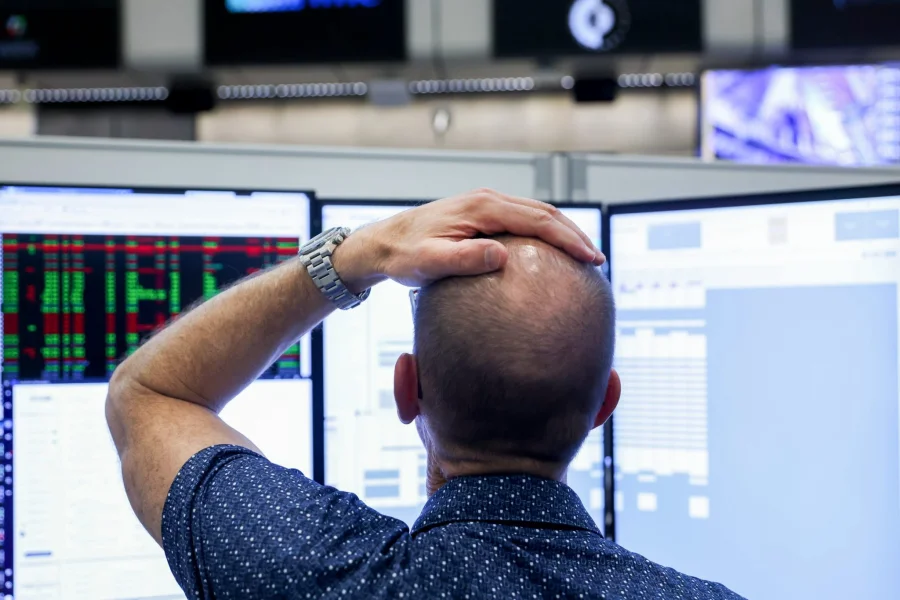
On Friday, the Nasdaq had its worst session in a year. By Monday, it all seemed like a bad dream — and for investors who bought the dip, a very profitable one.
Chip stocks lead the rebound after Friday’s rout
The chipmakers that suffered their worst session since 2020 on Friday — Micron and Broadcom — were Monday’s best performers, up 6.5% by midday. Wall Street appears to consider Friday as a welcome easing off of a record-setting rally, as opposed to a genuine repricing of the AI trade that other analysts warned of.
Why this matters for Indian and global investors
For Indian investors tracking US markets via mutual funds, ETFs, or direct stock holdings, this volatility is a reminder that AI-driven rallies can reverse sharply. But the quick rebound suggests the underlying demand for AI chips — from data centers to enterprise AI — remains intact. The question is whether this pattern of sharp selloffs followed by recoveries will hold.
How Friday’s crash unfolded
Friday’s selloff was triggered by a combination of profit-taking and concerns that AI stock valuations had become stretched. The Nasdaq dropped over 3%, its worst single-day decline in a year. Chip stocks, which had led the rally, were hit hardest. Micron fell nearly 8%, Broadcom dropped over 7%, and other semiconductor names followed.
Asia’s wake-up call: Kospi plunges 8%
New York’s bad dream was, overnight, Asia’s waking one. South Korea’s Kospi — the best-performing major index in the world this year — plunged as much as 8.8% at the open Monday, triggering a 20-minute trading halt, its third of 2026. It closed down 8.29%. Samsung Electronics and SK Hynix, the two memory-chip makers that together make up roughly half of the index, fell about 10% and 8% respectively. This highlights how deeply Asia’s tech-heavy markets are tied to the AI trade.
What Wall Street is saying about the rebound
Analysts at major investment banks have described Friday’s selloff as a “healthy correction” in a market that had risen too fast. “The AI trade is not broken,” one strategist told clients. “It’s just taking a breather.” Others caution that if earnings disappoint or AI spending slows, the next selloff could be deeper.
Is this a genuine buying opportunity or a trap?
The speed of the rebound — within two trading sessions — suggests strong underlying demand for AI-related stocks. But some analysts warn that the rally is narrow, concentrated in a handful of chipmakers and tech giants. If the broader economy weakens or interest rates stay high, the AI trade could face more serious headwinds.
Confirmed facts vs what remains unclear
Confirmed: Nasdaq had its worst session in a year on Friday. Chip stocks Micron and Broadcom rebounded 6.5% by Monday. Kospi fell 8.29% and triggered a trading halt. Unclear: Whether this rebound will sustain or if further volatility lies ahead. Whether the selloff was purely profit-taking or signals a shift in AI sentiment. No official statements from companies or regulators have been issued.
Why chipmakers like Micron and Broadcom matter
Micron and Broadcom are not household names like Nvidia, but they are critical to the AI supply chain. Micron produces high-bandwidth memory (HBM) chips essential for AI training. Broadcom designs custom AI accelerators for major cloud providers. Their performance is a proxy for the health of the entire AI ecosystem.
Risks and balanced view
Not everyone is convinced the AI trade is safe. Critics point to sky-high valuations, slowing growth in AI chip sales, and the risk of a bubble. “This feels like 1999 all over again,” one veteran investor warned. Others note that AI adoption is still in early stages, and the long-term thesis remains intact. The truth likely lies somewhere in between.
Wider trend: AI trade volatility becomes the new normal
This pattern — sharp selloffs followed by rapid recoveries — has become increasingly common in AI stocks. It reflects a market that is both deeply optimistic about AI’s potential and nervous about valuations. Investors should expect more such swings as the AI trade matures.
What investors should do now
For long-term investors, Friday’s dip and Monday’s rebound reinforce the importance of staying disciplined. Avoid panic selling during sharp drops. Consider dollar-cost averaging into AI-related ETFs or stocks. For short-term traders, volatility creates opportunities but also risks. Always have a clear exit strategy.
Future outlook: What could happen next
If AI earnings in the coming quarters meet or beat expectations, the rally could resume. If they disappoint, a deeper correction is possible. The next major catalyst will be earnings reports from Nvidia, Micron, and Broadcom later this year. Until then, expect continued volatility.
Our Take
Friday’s crash and Monday’s rebound are a textbook example of how AI trade volatility works in 2026. The underlying thesis — that AI will drive massive demand for chips and infrastructure — remains intact. But the market is no longer pricing in just growth; it’s pricing in perfection. That makes every dip a potential opportunity, but also every rally a potential trap. For Indian investors, the key takeaway is to stay invested but diversified, and not to bet the house on any single AI stock.
Frequently Asked Questions
What caused the AI trade’s worst day in a year?
Profit-taking and concerns about stretched valuations triggered a sharp selloff on Friday, with the Nasdaq dropping over 3%. Chip stocks like Micron and Broadcom were hit hardest.
Is the AI trade over?
Most analysts say no. The quick rebound on Monday suggests the selloff was a healthy correction, not a fundamental shift. However, risks remain if earnings disappoint or AI spending slows.
Should I buy AI stocks after the dip?
It depends on your risk tolerance and time horizon. Long-term investors may see this as a buying opportunity, but short-term volatility is likely to continue. Consider dollar-cost averaging.
How did Asian markets react to the US selloff?
South Korea’s Kospi plunged 8.29% on Monday, triggering a trading halt. Samsung and SK Hynix fell sharply, highlighting Asia’s deep exposure to the AI trade.