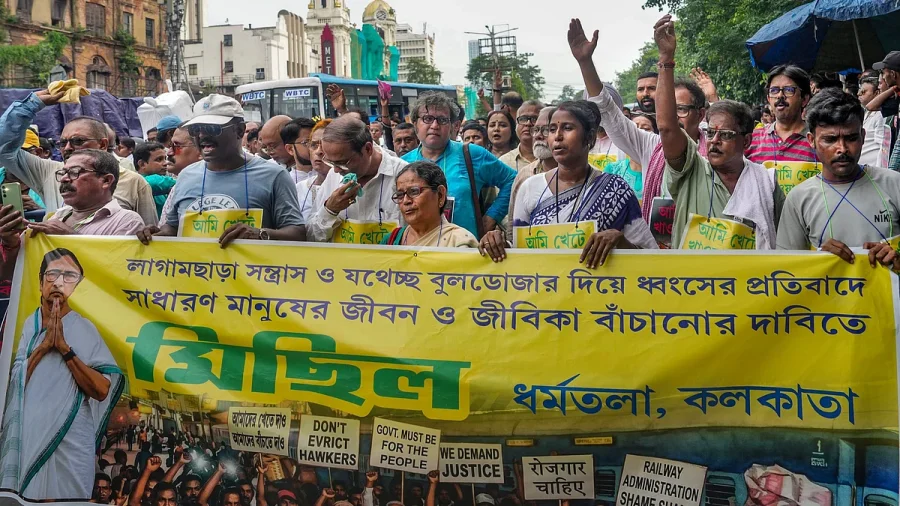
Just weeks after Trinamool Congress suffered a decisive defeat in the 2026 West Bengal Assembly elections, Mamata Banerjee was back on the streets of Kolkata on Wednesday — leading a protest march against the eviction of hawkers. The sight of the former chief minister walking at the front of a procession at Esplanade (Dharmatala) sent a clear signal: she is not retreating from public life, but recalibrating her political strategy.
Surprise protest catches party and administration off guard
Banerjee’s arrival at the protest site was described by party insiders as a surprise move that caught even many Trinamool leaders and sections of the administration off guard. Accompanied by party leaders Kunal Ghosh, Dola Sen, and Ratna Sur, she led a crowd of protesters who raised slogans against what they termed a “bulldozer policy” and carried placards demanding protection for hawkers’ livelihoods.
Why the hawker eviction issue matters now
The eviction of hawkers without adequate rehabilitation has emerged as a flashpoint in Kolkata, particularly affecting the urban poor who depend on street vending for their daily income. Banerjee described the evictions as “inhuman,” framing the issue as a test of the new government’s commitment to the rights of informal workers. For many in the city, the protest resonated as a defence of livelihoods against what they see as heavy-handed urban clearance drives.
From chief minister to opposition leader: a political shift
Banerjee’s return to the streets marks a significant shift in her political role. After 14 years as chief minister, she now leads a party that has been reduced to opposition in the state assembly. The protest is her first major public mobilization since the election defeat, signalling that Trinamool Congress will adopt a more confrontational, street-level approach to challenge the new government’s policies.
Who is affected by the eviction drive
The hawker eviction drive has primarily targeted street vendors in central Kolkata, including areas around Esplanade, Sealdah, and other busy commercial zones. Thousands of families depend on these vending spots for their livelihood, and many have reported being evicted without prior notice or alternative arrangements. The issue has drawn attention from civil rights groups and opposition parties, who argue that the evictions violate Supreme Court guidelines on hawker rehabilitation.
Official response and government’s position
The new state government has defended the eviction drive as necessary for decongesting Kolkata’s streets and improving traffic flow. Officials have stated that hawkers will be relocated to designated markets, though critics say the rehabilitation process has been slow and inadequate. Banerjee’s protest directly challenges this narrative, demanding that evictions be halted until proper rehabilitation is in place.
What the “bulldozer policy” accusation means
The term “bulldozer policy” has become a rallying cry for opposition parties in West Bengal, accusing the new government of using heavy-handed tactics to clear public spaces without addressing the human cost. Banerjee’s use of this phrase during the protest taps into broader anxieties about the treatment of informal workers and the pace of urban transformation in Kolkata.
Confirmed facts vs what remains unclear
What is confirmed: Banerjee led a protest march at Esplanade on Wednesday, accompanied by Trinamool leaders. She described the evictions as inhuman and demanded rehabilitation. The protest was against ongoing hawker evictions. What remains unclear: the exact number of hawkers affected, the timeline for any rehabilitation plan, and whether this protest marks the beginning of a sustained opposition campaign or a one-off mobilization.
Trinamool’s political recalibration after electoral defeat
The 2026 election loss was a major setback for Trinamool Congress, which had governed West Bengal since 2011. Banerjee’s return to street protests suggests the party is pivoting to a more grassroots, confrontational style of opposition — reminiscent of her early political career when she led agitations against the Left Front government. The hawker eviction issue offers a ready-made platform to reconnect with the urban poor and working-class voters who were once her core support base.
Risks and balanced view
While the protest has energized party workers, critics argue that Banerjee’s return to the streets may be a tactical move to deflect attention from internal party dissent and the reasons for the electoral defeat. Some analysts question whether street protests alone can rebuild the party’s organizational strength or address the governance failures that led to the loss. The new government may also use the protests to portray Trinamool as obstructionist rather than constructive.
Wider trend: street politics in post-election India
Banerjee’s move fits a broader pattern in Indian politics where defeated chief ministers or opposition leaders return to street-level agitations to reclaim political relevance. Similar strategies have been employed by leaders in other states after electoral defeats, using local issues like farmer protests, land acquisition, or urban displacement to mobilize support. The hawker eviction issue, with its direct impact on daily life, offers a potent symbol of resistance against perceived administrative overreach.
What this means for Kolkata’s hawkers and residents
For Kolkata’s hawkers, the protest has brought renewed attention to their plight, but the immediate impact on evictions remains uncertain. For residents, the issue highlights the tension between urban development and the rights of informal workers. The coming weeks will reveal whether the government offers a concrete rehabilitation plan or whether the eviction drive continues despite opposition.
Future outlook
Banerjee’s protest could be the first of many such mobilizations as Trinamool Congress seeks to establish itself as a credible opposition force. The hawker eviction issue may become a sustained campaign, especially if the government does not address rehabilitation demands. However, the party’s ability to translate street protests into electoral recovery will depend on broader organizational rebuilding and policy alternatives.
Our Take
Mamata Banerjee’s return to the streets is a politically significant moment — not just for West Bengal, but for understanding how opposition leaders recalibrate after electoral defeat. The hawker eviction issue is a legitimate concern that affects thousands of families, and Banerjee’s decision to lead from the front underscores her instinct for grassroots mobilization. However, the long-term effectiveness of this strategy will depend on whether it leads to concrete policy outcomes or remains a symbolic gesture. For now, the protest has put the spotlight back on the human cost of urban clearance drives — a conversation that deserves more attention regardless of political affiliation.
Frequently Asked Questions
Why did Mamata Banerjee lead a protest against hawker evictions?
Mamata Banerjee led the protest to oppose the eviction of hawkers without adequate rehabilitation, describing the process as “inhuman.” The protest also signals her return to opposition street politics after Trinamool Congress lost the 2026 West Bengal Assembly elections.
What is the “bulldozer policy” that protesters are accusing the government of?
The term “bulldozer policy” refers to the alleged use of heavy-handed tactics by the new state government to clear hawkers and other encroachments from public spaces without providing proper rehabilitation or alternative arrangements.
How many hawkers are affected by the eviction drive in Kolkata?
The exact number of affected hawkers is not officially confirmed, but the eviction drive has targeted street vendors in central Kolkata areas including Esplanade and Sealdah, impacting thousands of families who depend on street vending for their livelihood.
What is the government’s response to the protest?
The new state government has defended the eviction drive as necessary for decongesting Kolkata’s streets and improving traffic flow, stating that hawkers will be relocated to designated markets. Critics say the rehabilitation process has been slow and inadequate.