

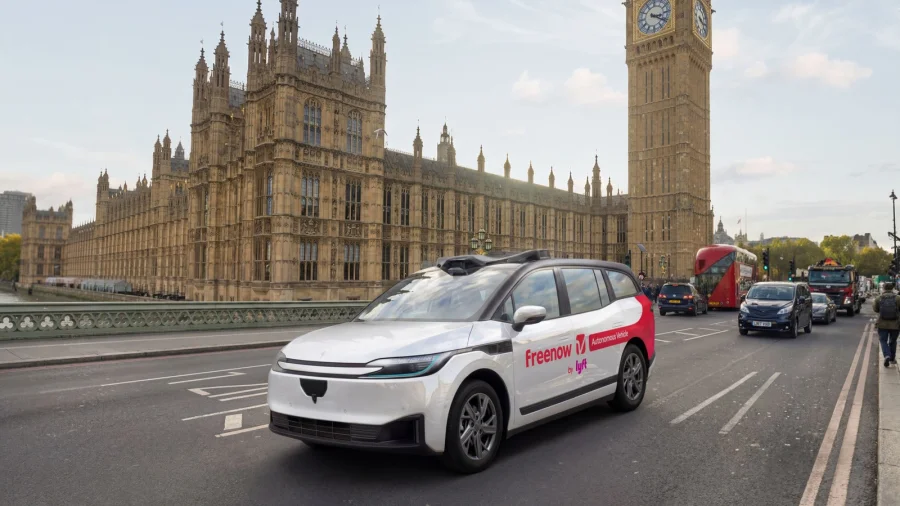
London’s streets are now home to a new kind of ride. Lyft and Baidu have begun testing robotaxis in the UK capital, bringing autonomous ride-hailing to one of the world’s busiest urban environments. The trial, which also involves German ride-hailing platform Freenow, fulfills a commitment made by the companies last year to expand self-driving technology beyond China and the United States.
Why London Became the Testing Ground
London presents a unique challenge for autonomous vehicles: narrow streets, heavy traffic, unpredictable weather, and complex road rules. Baidu, which has already deployed robotaxis in several Chinese cities, sees the UK capital as a critical proving ground for its Apollo platform. Lyft’s role is to provide the ride-hailing infrastructure, while Freenow handles local operations and driver partnerships.
How the Robotaxi Trial Works
For now, the robotaxis are operating on pre-mapped routes with safety drivers behind the wheel. The vehicles use Baidu’s autonomous driving system, which combines cameras, lidar, and radar to navigate. Passengers are not yet being picked up; the initial phase focuses on data collection and system validation. Lyft and Baidu have not disclosed the exact number of vehicles or specific London neighborhoods involved.
What This Means for London Commuters
If the trial succeeds, Londoners could eventually hail a driverless taxi through the Lyft or Freenow app. That would mean lower fares, reduced wait times, and fewer emissions — but also concerns about job losses for traditional drivers and safety in a city known for its chaotic traffic. The companies have stressed that safety is the top priority, with extensive simulation testing completed before real-world deployment.
Regulatory Hurdles and Public Trust
The UK government has been cautiously supportive of autonomous vehicle testing, but full commercial deployment requires approval from the Department for Transport. Public trust remains a major barrier. A 2024 survey found that only 35% of Britons would feel safe in a driverless car. Baidu and Lyft will need to demonstrate flawless safety records to win over regulators and riders alike.
Baidu’s Global Ambitions
For Baidu, London is a strategic beachhead in Europe. The Chinese tech giant has already tested robotaxis in Beijing, Shanghai, and Shenzhen, and is eyeing expansion into the Middle East and Southeast Asia. Partnering with Lyft and Freenow gives Baidu access to established ride-hailing networks without building its own from scratch. The London trial is a low-risk way to prove its technology can handle Western driving conditions.
Lyft and Freenow’s Strategic Play
Lyft has been scaling back its own autonomous vehicle development, instead choosing to partner with technology providers like Baidu. Freenow, which operates across Europe, sees robotaxis as a way to differentiate itself from Uber. The London trial allows both companies to test the waters without massive capital expenditure.
Confirmed Facts vs What Remains Unclear
What is confirmed: Baidu, Lyft, and Freenow have started testing robotaxis in London as promised. Safety drivers are present. The trial is in its early data-collection phase. What remains unclear: the exact number of vehicles, specific routes, timeline for public rides, and whether the UK government has granted formal approval beyond testing permits. No passenger accidents or incidents have been reported.
Risks and Balanced View
Critics argue that robotaxis in London face unique dangers: cyclists, pedestrians, narrow lanes, and roundabouts. There are also concerns about data privacy, given Baidu’s Chinese ownership. Supporters counter that autonomous vehicles could reduce the 1,600 annual road deaths in the UK by eliminating human error. The trial is too early to draw conclusions, but it will be closely watched by regulators and competitors.
Wider Trend: The Global Robotaxi Race
London joins a growing list of cities hosting robotaxi trials, including San Francisco (Waymo), Phoenix (Waymo and Cruise), Beijing (Baidu), and Shanghai (AutoX). The global autonomous ride-hailing market is projected to reach $2 trillion by 2030, according to some estimates. The London trial is a small but significant step in that direction.
Practical Guidance for Londoners
If you see a robotaxi on London streets, do not approach or attempt to hail it — the vehicles are not yet available for public use. The companies advise giving them space, as they may stop unexpectedly during testing. For those interested in trying a robotaxi when available, keep an eye on the Lyft and Freenow apps for future announcements.
Future Outlook
If the London trial meets safety benchmarks, Baidu and Lyft could expand to other UK cities like Manchester or Birmingham within two years. Full commercial launch in London is likely 3–5 years away, pending regulatory approval and public acceptance. The companies have not ruled out eventually removing safety drivers entirely.
Our Take
The Lyft-Baidu robotaxi trial in London is more than a technical exercise — it’s a test of whether autonomous vehicles can work in one of the world’s most challenging urban environments. Success would open the door to a massive European market. Failure would reinforce skepticism about self-driving technology. For now, the cautious, data-driven approach is the right one. The real test will come when the safety drivers step out.
Frequently Asked Questions
Are Lyft and Baidu robotaxis available for public rides in London right now?
No. The testing is in an early phase with safety drivers and no passengers. Public rides are not yet available.
Which companies are involved in the London robotaxi trial?
Baidu provides the autonomous driving technology, Lyft handles the ride-hailing platform, and Freenow manages local operations.
Where in London are the robotaxis being tested?
The exact routes have not been disclosed, but testing is believed to be in central and suburban areas with pre-mapped roads.
When will robotaxis be available for everyone in London?
There is no confirmed timeline. Experts estimate 3–5 years for full commercial launch, pending regulatory approval and successful testing.