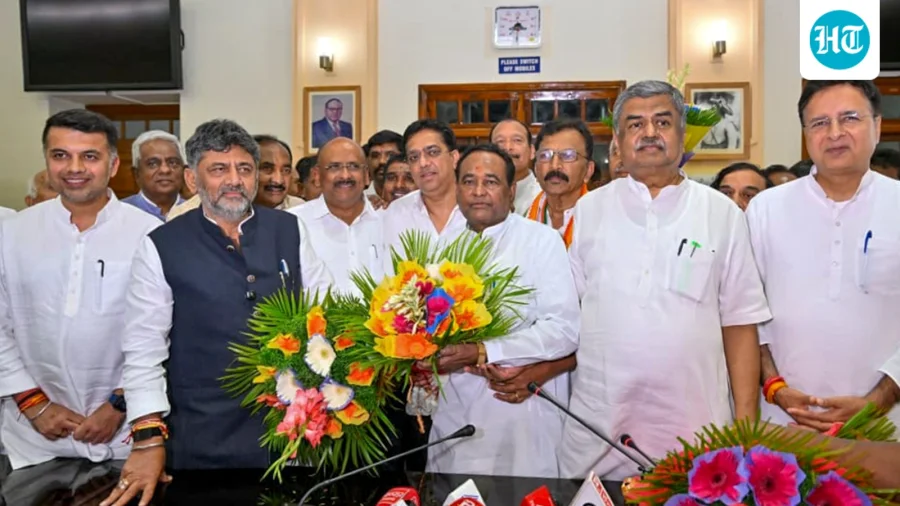
The Congress party has delivered a stunning performance in the Karnataka Legislative Council biennial elections, winning five of the seven seats up for grabs. The result, which saw the BJP secure only two seats, was driven by unexpected cross-voting from BJP and JD(S) MLAs, handing the ruling party a decisive victory in the state's upper house.
How Congress Secured the Fifth Seat: The Cross-Voting Factor
The election, held on Thursday at the Karnataka Vidhana Soudha, saw eight candidates contesting for seven MLC seats to be elected by MLAs. While the Congress was expected to win four seats based on its strength in the assembly, cross-voting by MLAs from the BJP and its ally JD(S) allowed the party to clinch a fifth seat. This unexpected shift in loyalty has sent shockwaves through the opposition ranks.
Why This Result Matters for Karnataka Politics
The outcome is a significant political statement. It not only strengthens the Congress's position in the Legislative Council but also exposes cracks within the BJP-JD(S) alliance. For the Congress government led by Chief Minister Siddaramaiah and Deputy CM DK Shivakumar, this victory is a powerful endorsement of their governance and a major morale booster. For the BJP, it raises serious questions about internal discipline and alliance management.
Timeline of the Election and Counting
Voting for the seven MLC seats took place on Thursday at the Vidhana Soudha. The counting of votes began at 5 PM on the same day. The results were declared late in the evening, with the Congress emerging as the clear winner. The entire process was conducted under tight security.
Who Benefits and Who Loses: The Human Impact
For the Congress party, this win translates into greater influence in the Legislative Council, which can help in passing key bills. For the BJP and JD(S), the loss is a blow to their collective strength and a sign of potential internal dissent. The cross-voting also highlights the personal equations and loyalties of individual MLAs, which can have long-term implications for party discipline.
Official Reactions: Congress Celebrates, BJP Acknowledges Setback
Congress leaders, including DK Shivakumar, hailed the result as a victory for the party's organizational strength and the government's pro-people policies. The BJP, while acknowledging the cross-voting, maintained that it would address the issue internally. The JD(S) expressed disappointment over the defection of its MLAs.
Analysis: What the Cross-Voting Reveals About Alliance Dynamics
The cross-voting by BJP and JD(S) MLAs is not just a numerical loss; it is a symptom of deeper dissatisfaction within the opposition ranks. It suggests that the BJP-JD(S) alliance, which was formed to counter the Congress, is not as cohesive as it appears. This could embolden the Congress to push for more aggressive political moves in the state.
Confirmed Facts vs What Remains Unclear
Confirmed: Congress won 5 seats, BJP won 2 seats. Cross-voting by BJP and JD(S) MLAs occurred. The election was for 7 MLC seats. Unclear: The exact number of MLAs who cross-voted from each party. The specific reasons for their defection. Whether any disciplinary action will be taken by the BJP or JD(S) against the cross-voters.
Risks and Balanced View: The Other Side of the Victory
While the Congress has reason to celebrate, the victory is partly built on the instability of its opponents. The cross-voting could be a one-off event, and the BJP-JD(S) alliance may take steps to prevent a repeat. Furthermore, the Congress must now manage the expectations of its own MLAs, who may seek rewards for their loyalty. The result does not change the fundamental arithmetic of the assembly, where the Congress still holds a majority.
Wider Trend: Cross-Voting as a Political Weapon in Karnataka
Cross-voting in MLC elections is not new to Karnataka. It has been a recurring feature, often used by parties to embarrass their rivals or to test the loyalty of their own MLAs. This election is a textbook example of how a ruling party can exploit divisions within the opposition to consolidate its own power.
Practical Guidance for Political Observers and Voters
For political analysts, this result is a key indicator of the health of the BJP-JD(S) alliance. For voters, it is a reminder that MLC elections, while less visible than assembly polls, can have a significant impact on state governance. The newly elected MLCs will play a role in shaping legislation and holding the government accountable.
Future Outlook: What Could Happen Next
The immediate fallout will likely involve internal reviews within the BJP and JD(S). The Congress may use this momentum to push for more legislative victories. The next major test for the alliance will be the upcoming local body elections. The cross-voting incident could also lead to a realignment of political loyalties in the state.
Our Take
This election result is more than just a numbers game. It is a clear signal that the Congress has successfully consolidated its position in Karnataka, while the BJP-JD(S) alliance is struggling with internal cohesion. The cross-voting is a symptom of a larger problem for the opposition: a lack of a unified narrative and a failure to keep its flock together. For the Congress, the challenge now is to convert this political victory into sustained governance gains.
Frequently Asked Questions
How many MLC seats were up for election in Karnataka?
Seven MLC seats were up for election, with eight candidates in the fray. The elections were held by MLAs of the Karnataka Legislative Assembly.
Why did cross-voting happen in the Karnataka MLC elections?
Cross-voting occurred when MLAs from the BJP and JD(S) voted for Congress candidates instead of their own party's nominees. This is often driven by personal loyalties, dissatisfaction with the party leadership, or political calculations.
What is the impact of this result on the Karnataka government?
The result strengthens the Congress's position in the Legislative Council, making it easier for the government to pass bills and manage the legislative agenda. It is a major morale booster for the ruling party.
Will the BJP or JD(S) take action against the cross-voting MLAs?
It is possible, but not confirmed. Parties often issue show-cause notices or take disciplinary action against MLAs who defy the party whip. However, the specific actions will depend on internal party decisions.