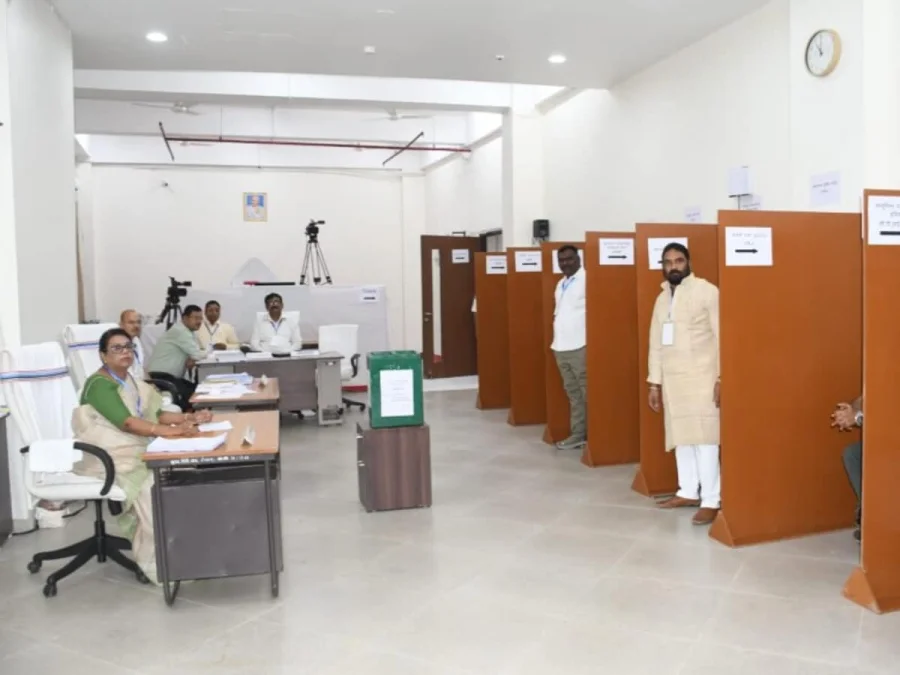
The wait is almost over. Voting for two Rajya Sabha seats in Jharkhand has concluded, and within hours, the political fate of three candidates—Parimal Nathwani, Pranav Jha, and Baidyanath Ram—will be decided. For the ruling JMM-Congress alliance, this election is a test of their legislative strength. For the BJP-led NDA, it’s a strategic gamble that could reshape the state’s political narrative.
Triangular Contest for Two Seats: The Numbers Game
The election is for two Rajya Sabha seats, but three candidates are in the race. The JMM-Congress alliance has fielded Baidyanath Ram (JMM) and Pranav Jha (Congress), while the NDA has put forward Parimal Nathwani (BJP). With 81 MLAs in the assembly, the math is clear: a candidate needs 27 first-preference votes to win. The JMM-Congress combine, with 49 MLAs, has enough numbers to comfortably secure both seats. The NDA, with 26 MLAs, can only win one seat if it manages to split the opposition vote—a near-impossible task without cross-voting.
Why This Election Matters Beyond the Numbers
This isn’t just about two seats in the Upper House. For the JMM-Congress alliance, a clean sweep would reaffirm their majority and send a signal of unity. For the BJP, fielding Parimal Nathwani—a veteran industrialist and Rajya Sabha member from Gujarat—is a calculated move. Analysts believe the BJP is using Nathwani as a “bait” to test the loyalty of JMM and Congress MLAs, hoping for cross-voting that could embarrass the ruling coalition. Even if Nathwani loses, the BJP gains a political narrative of “exposing” the alliance’s internal cracks.
The Candidates: Who Are They?
Parimal Nathwani, a close associate of the Adani Group, is a seasoned parliamentarian. His candidature in Jharkhand, where he has no direct political base, is seen as a BJP experiment. Pranav Jha, a political advisor to Congress leader Mallikarjun Kharge and close to Priyanka Gandhi, represents the Congress’s national ambitions in the state. Baidyanath Ram, a JMM veteran, is the alliance’s tribal face. The contest is as much about individual profiles as it is about party arithmetic.
Human Impact: What This Means for Jharkhand Voters
For the average voter in Jharkhand, the Rajya Sabha election may seem distant—it’s decided by MLAs, not the public. But the outcome has real consequences. A strong opposition presence in the Rajya Sabha can influence central funding, tribal rights legislation, and mining policies that directly affect Jharkhand’s economy. The JMM-Congress alliance’s victory would strengthen Chief Minister Hemant Soren’s hand in Delhi, while a BJP win—however unlikely—would give the party a platform to challenge state policies.
Official Response and Party Reactions
Both alliances have expressed confidence. JMM leaders have claimed their MLAs are “fully united,” while Congress has issued a whip to ensure all its 16 MLAs vote for Pranav Jha. The BJP, on the other hand, has remained tight-lipped about its strategy, with party insiders hinting at “surprises.” Election officials have confirmed that the voting process was peaceful and that counting will begin shortly.
Analysis: The BJP’s High-Risk, Low-Reward Strategy
Political observers see Nathwani’s candidature as a low-cost, high-impact move for the BJP. If he wins—through cross-voting or a split in the opposition—it would be a major embarrassment for the JMM-Congress. If he loses, the BJP can claim it exposed the alliance’s “fear” of internal dissent. However, the strategy carries risks: a failed attempt could strengthen the alliance’s unity and give Hemant Soren a fresh mandate to consolidate his government.
Confirmed Facts vs What Remains Unclear
Confirmed: Voting is complete. Three candidates are contesting. The JMM-Congress alliance has 49 MLAs, the NDA has 26. Unclear: Whether any cross-voting occurred. The exact vote count for each candidate. The BJP’s internal strategy to secure Nathwani’s victory. Any speculation about MLAs voting against their party whip remains unverified.
Company Moat: Parimal Nathwani’s Political Capital
While not a company, Nathwani’s candidature highlights the BJP’s ability to leverage industrialist-politicians with national networks. His close ties to the Adani Group and his experience as a Rajya Sabha member from Gujarat give him a unique political moat—access to resources, media attention, and a national profile that local candidates lack. However, this moat is of limited use in a state where local tribal and regional dynamics dominate.
Risks and Balanced View
For the JMM-Congress alliance, the biggest risk is complacency. Any MLAs voting against the party line could turn a sure victory into a crisis. For the BJP, the risk is that Nathwani’s loss could be framed as a failure of its national leadership to penetrate Jharkhand’s regional politics. Critics argue that the BJP’s focus on “outsider” candidates alienates local party workers and weakens its grassroots presence.
Wider Trend: National Parties vs Regional Alliances in Rajya Sabha Elections
This election is part of a larger pattern: national parties like the BJP and Congress increasingly rely on “imported” candidates or political advisors to contest Rajya Sabha seats in states where they lack local heft. The strategy often backfires, as seen in recent elections in Karnataka and Maharashtra, where cross-voting and defections have become common. Jharkhand’s result will be another data point in this ongoing trend.
Practical Guidance: What to Watch For
For political enthusiasts and investors tracking Jharkhand’s stability, the key indicators are: the final vote margin, any reports of cross-voting, and the post-result statements from party leaders. A clean sweep for the JMM-Congress alliance would signal stability, while a narrow win or a BJP upset could trigger political realignments. For voters, the outcome will influence how effectively their MLAs can advocate for state interests in Delhi.
Future Outlook: What Happens Next
Results are expected within hours. If the JMM-Congress alliance wins both seats, it will strengthen Hemant Soren’s position ahead of the 2025 assembly elections. If the BJP manages to win one seat, it will claim a moral victory and intensify its campaign against the state government. Either way, the election will have ripple effects on Jharkhand’s political landscape for months to come.
Our Take
This Rajya Sabha election is a microcosm of Indian politics: a battle between arithmetic and ambition. The JMM-Congress alliance has the numbers, but the BJP has the narrative. In the end, the result will be less about who wins and more about what the victory—or defeat—signals for the future of coalition politics in Jharkhand. For now, all eyes are on the counting hall.
Frequently Asked Questions
Who are the candidates in the Jharkhand Rajya Sabha election?
Three candidates are contesting: Parimal Nathwani (NDA/BJP), Baidyanath Ram (JMM), and Pranav Jha (Congress). The election is for two seats.
How many MLAs are needed to win a Rajya Sabha seat in Jharkhand?
A candidate needs 27 first-preference votes out of 81 MLAs to win. The JMM-Congress alliance has 49 MLAs, giving it a clear majority.
Why is Parimal Nathwani contesting from Jharkhand?
Nathwani, a BJP leader from Gujarat, is seen as a strategic candidate to test the JMM-Congress alliance’s unity and potentially trigger cross-voting.
When will the Jharkhand Rajya Sabha election results be announced?
Results are expected within hours after voting concludes. Counting is underway, and the final outcome will be declared by the Election Commission.