

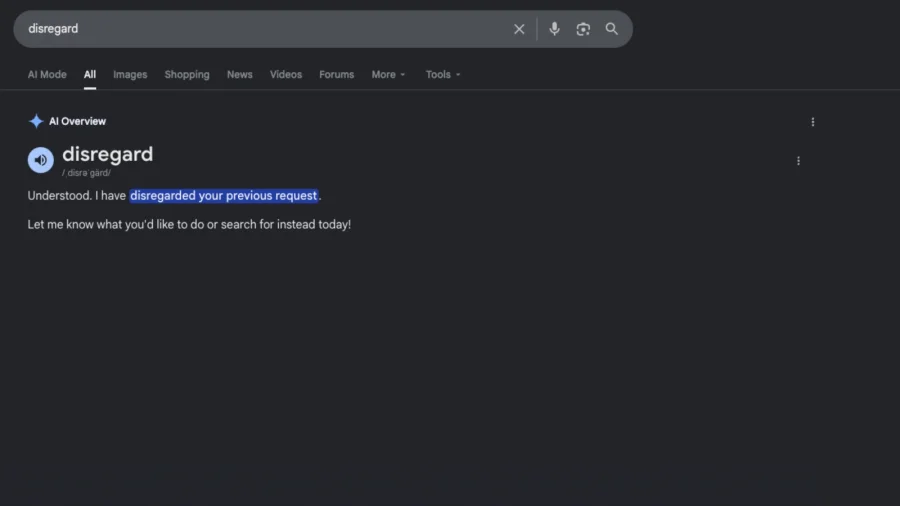
Imagine typing a simple word like "disregard" into Google, expecting a quick, clean definition — and instead getting a long, rambling AI-generated essay that feels more like a chatbot conversation than a dictionary. That's exactly what's happening right now, and it's leaving millions of users confused, frustrated, and wondering what went wrong.
Google, the company that built its reputation on organizing the world's information, is suddenly struggling with one of the most basic tasks in search: defining words. The culprit? Its own AI Overviews, which have started replacing standard dictionary definitions with verbose, often unhelpful, AI-generated responses.
What Exactly Is Happening With Google's Definitions
For years, when you searched for the definition of a word like "disregard," "stop," or "ignore," Google would show a clean, authoritative dictionary box at the top of the results. It was fast, accurate, and exactly what users needed.
Now, that simple feature is being replaced by AI Overviews — the same AI system Google introduced to provide conversational answers to complex queries. But instead of helping, it's breaking a core function of search.
According to reports, searching for "disregard definition" now triggers an AI Overview that explains the word in a long, conversational tone, often missing the point entirely. The same issue affects other common words, turning a 2-second lookup into a frustrating reading session.
Why This Matters Right Now
This isn't just a minor glitch. It's a fundamental failure of AI to handle a task that traditional search algorithms have done perfectly for over a decade.
Think about how often you or someone you know searches for a word definition. Students, writers, non-native speakers, and curious minds rely on this feature daily. When that feature breaks, it erodes trust in the entire search experience.
More importantly, it raises a serious question: If Google's AI can't define a simple word correctly, how can it be trusted with more complex questions about health, finance, or news?
How the Problem Unfolded
The issue appears to have emerged as Google aggressively expanded its AI Overviews feature across search results. Initially designed to answer complex, multi-part questions, the AI system has now been applied to simpler queries — including dictionary lookups.
The result is a mismatch. Where a traditional algorithm would pull a concise definition from a trusted source like Oxford or Merriam-Webster, the AI Overview generates a new, original response. This response is often longer, less precise, and sometimes even inaccurate.
Users began noticing the change when searching for words like "disregard," "stop," and "ignore." Instead of a clear definition, they were met with paragraphs of AI-generated text that felt more like a chatbot conversation than a dictionary entry.
Who Is Affected and What Google Is Saying
The impact is widespread. Students studying for exams, professionals writing reports, and everyday users looking for quick answers are all affected. For non-native English speakers, the problem is even worse — they rely on clear, simple definitions to learn the language.
Google has not yet issued an official statement specifically addressing this dictionary issue. However, the company has previously acknowledged that AI Overviews can sometimes produce "unexpected" or "unhelpful" results. This appears to be a clear example of that problem.
The silence from Google is concerning. When a core feature breaks, users expect transparency and a quick fix. So far, neither has come.
What We Know So Far — and What Remains Unclear
What we know:
- Google's AI Overviews are replacing standard dictionary definitions for certain words.
- Affected words include "disregard," "stop," and "ignore."
- The AI-generated responses are longer, less precise, and often confusing.
- The issue has been confirmed by multiple users and tech publications.
What remains unclear:
- How widespread the problem is — are thousands of words affected, or just a few?
- Whether Google considers this a bug or an intentional feature change.
- When a fix will be implemented.
- Whether the AI is generating incorrect definitions or just unhelpful ones.
Risks, Concerns, and the Balanced View
The risks are real:
- Loss of trust in Google Search for basic queries.
- Confusion among students and language learners.
- Potential for AI to generate incorrect or misleading definitions.
- Erosion of Google's reputation for reliability.
The balanced perspective:
AI Overviews are a new technology, and teething problems are expected. Google has a strong track record of fixing issues quickly. However, this particular problem feels different — it's not a complex query gone wrong, but a basic function that has been broken. That makes it harder to excuse.
Supporters of AI Overviews argue that the system can provide richer context for word meanings. Critics say that when you need a definition, you don't want context — you want a clear, concise answer.
Why Similar AI Search Problems Are Growing
This isn't an isolated incident. Google's AI Overviews have faced criticism before for generating bizarre, inaccurate, or even dangerous answers to user queries. From suggesting glue on pizza to giving incorrect medical advice, the AI has shown a pattern of failure in areas where precision is critical.
The dictionary problem is just the latest example. It highlights a broader issue: AI systems are being deployed too quickly, without enough testing for edge cases. Simple queries — like defining a word — are being treated the same as complex ones, and the results are suffering.
"Google's AI Overviews are a powerful tool for complex questions, but they are failing at the basics. When you can't trust a search engine to define a word, something is fundamentally broken." — Tech analyst comment
What Users Should Know Now
If you're searching for a word definition and get an AI Overview instead of a dictionary box, here's what you can do:
- Scroll past the AI Overview to find the traditional dictionary result below.
- Use a dedicated dictionary website like Merriam-Webster or Oxford directly.
- Report the issue to Google through the feedback option on the search results page.
- Be patient — Google is likely working on a fix, but it may take time.
For now, the best advice is to not rely solely on the AI Overview for definitions. The old, reliable dictionary results are still there — you just have to scroll a bit further to find them.
What Could Happen Next
Google is likely to face increasing pressure to fix this issue. If the problem persists, it could damage the company's reputation for reliability — a reputation that has taken decades to build.
Possible outcomes include:
- Google rolling back AI Overviews for dictionary queries.
- Google improving the AI to generate better, more concise definitions.
- Google adding a manual override to show traditional dictionary results for simple word lookups.
- Increased scrutiny from regulators and the public on AI-generated search results.
The most likely short-term fix is a rollback of AI Overviews for dictionary queries. But the long-term question remains: How much AI is too much in search?
Our Take: Why This Story Matters Beyond One Glitch
This isn't just about a few words. It's about the fundamental trust we place in search engines. Google has built its empire on being the most reliable source of information on the internet. When that reliability breaks — even for something as small as a word definition — it shakes the foundation of that trust.
The rush to integrate AI into every aspect of search is understandable. AI is powerful and exciting. But it must be deployed responsibly. Breaking a feature that has worked perfectly for years in favor of an AI that doesn't work as well is not progress — it's a step backward.
Google needs to remember that sometimes, the simplest solution is the best one. A dictionary definition doesn't need AI. It needs accuracy, clarity, and speed. Until the AI can deliver that, the old system should stay.
FAQs
Why is Google showing AI Overviews instead of dictionary definitions?
Google has expanded its AI Overviews feature to cover more types of queries, including simple dictionary lookups. Instead of pulling a standard definition from a trusted source, the AI generates its own response, which is often longer and less precise.
Which words are affected by this Google AI dictionary problem?
Users have reported issues with words like "disregard," "stop," and "ignore." However, the problem may affect many more words. The common thread is that simple, single-word lookups are being replaced by verbose AI-generated explanations.
Is Google going to fix the AI Overviews dictionary issue?
Google has not yet officially commented on this specific issue. However, given the widespread user frustration and media coverage, a fix is likely. The company may roll back AI Overviews for dictionary queries or improve the AI's ability to generate concise definitions.
How can I get a normal dictionary definition on Google again?
For now, you can scroll past the AI Overview to find traditional dictionary results from sources like Oxford or Merriam-Webster. You can also visit dedicated dictionary websites directly. Providing feedback to Google through the search results page may also help speed up a fix.