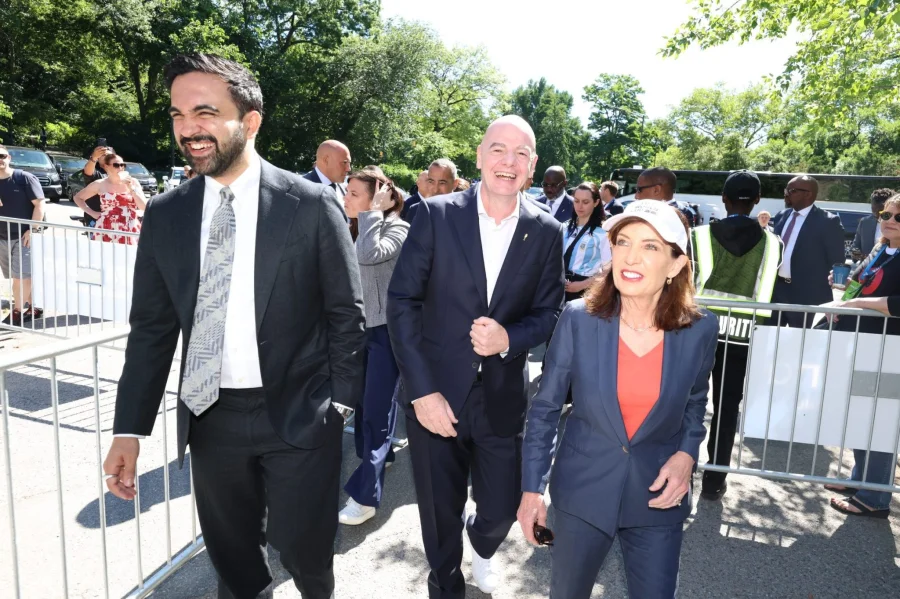
On Monday, New York Gov. Kathy Hochul and Mayor Zohran Mamdani stood in Central Park to announce a free watch party for 50,000 New Yorkers on the Great Lawn for the World Cup final. The State of New York is spending $6 million so that residents who cannot afford the most-watched sporting event on earth can at least watch it together. “In a moment where sports, experiences, and memories have grown increasingly unattainable for working people,” Mamdani said, “we will make this viewing party 100% free.”
Standing nearby was FIFA president Gianni Infantino, who last month defended the exorbitant costs of the world’s most prestigious sporting event and blamed them on “market rates” that apply in the U.S.
What FIFA says about ticket pricing
Infantino has argued that World Cup ticket prices are simply a reflection of the U.S. market, where demand for major sporting events is high and prices naturally rise. “We have to look at the market,” he said, suggesting that FIFA is merely responding to economic realities rather than setting prices arbitrarily.
FIFA has pointed to the scale of the tournament — 104 matches across three countries — and the costs of staging such an event as justification for the pricing structure. The organization has also noted that some lower-tier tickets remain available for certain matches, though critics say these are far too few to meet demand.
Why economists say the market was rigged by design
Economists and sports business experts have pushed back sharply against Infantino’s framing. They argue that FIFA itself controls the supply of tickets — the most critical variable in any pricing equation — and has deliberately kept supply tight to drive up prices.
“This is not a free market,” said one sports economist quoted in the Fortune report. “FIFA decides exactly how many tickets to release, to whom, and at what price. They create artificial scarcity, then point to the resulting high prices as ‘market rates.’ That’s circular logic.”
The organization also controls the secondary market through its official resale platform, limiting competition and keeping prices elevated. Critics say this is market manipulation, not market responsiveness.
How the pricing controversy unfolded
The 2026 World Cup, hosted by the United States, Canada, and Mexico, has been defined by sticker shock since ticket sales opened. Prices for the final reportedly reached thousands of dollars, with even group-stage matches costing hundreds. Fans, many of whom had saved for years to attend, expressed outrage on social media and in public forums.
Infantino’s “market rates” defense came in response to mounting criticism. But rather than quelling the controversy, it intensified the debate over whether FIFA is prioritizing profit over the global football community that sustains the tournament.
Who is affected by the high prices
The impact is most acute for working-class families, young fans, and international visitors from countries where the cost of living is far lower than in the U.S. For many, attending a World Cup match has become a once-in-a-lifetime dream that is now financially out of reach.
In New York, the free watch party is a direct acknowledgment of this reality. “We will make this viewing party 100% free,” Mamdani said, framing the event as a corrective to an increasingly exclusionary sports economy. The $6 million investment by the state covers the screen, sound system, security, and logistics for 50,000 people.
FIFA’s response to the criticism
FIFA has not directly commented on the New York watch party. However, Infantino’s earlier remarks suggest the organization sees high prices as an unavoidable feature of hosting the tournament in North America. FIFA has also emphasized that it reinvests revenue into global football development, though critics question how much actually reaches grassroots programs.
The organization has not indicated any plan to reduce prices or increase the supply of affordable tickets.
What the ‘market rates’ argument really means
At its core, the debate is about who defines the market. FIFA controls the product, the supply, the distribution channels, and the pricing tiers. Economists argue that when one entity controls all these variables, the resulting prices are not “market rates” in any meaningful sense — they are administered prices set by a monopoly supplier.
“If FIFA truly wanted to test market rates, they would allow open competition among ticket sellers,” one analyst noted. “Instead, they control every aspect of the transaction and then claim the outcome is natural.”
Confirmed facts vs what remains unclear
Confirmed: Infantino said ticket prices reflect U.S. market rates. New York State is spending $6 million on a free watch party for 50,000 people. Ticket prices for the 2026 World Cup are among the highest in tournament history.
Unclear: Whether FIFA will adjust pricing or release more affordable tickets. The exact breakdown of how FIFA sets its ticket supply is not publicly detailed. The long-term impact on fan loyalty and tournament attendance is speculative.
Why FIFA’s model matters beyond ticket prices
FIFA’s pricing strategy is not just about one tournament. It sets a precedent for how major sporting events are monetized in the future. If the 2026 World Cup proves that fans will pay extreme prices, future tournaments — including the 2034 edition in Saudi Arabia — could follow the same model, further excluding ordinary fans.
The organization’s financial structure also matters. FIFA reported revenues of over $7 billion in the last World Cup cycle, much of it from broadcasting rights and sponsorships. Ticket sales, while significant, are a smaller portion. Critics say this makes the high prices even harder to justify.
Risks and balanced view
Supporters of FIFA’s approach argue that high prices reflect genuine demand and that the revenue funds football development worldwide. They also note that some affordable tickets exist, though they are limited.
Critics counter that FIFA’s monopoly control over ticket supply distorts the market, that the organization prioritizes profit over access, and that the “market rates” defense is misleading. The New York watch party, they say, is a necessary public intervention to restore access.
Wider trend: The growing unaffordability of live sports
The World Cup pricing controversy is part of a broader trend across professional sports. From Premier League tickets to Super Bowl seats, the cost of attending live events has risen sharply, often outpacing inflation. Clubs and governing bodies increasingly rely on premium hospitality and corporate sales, while ordinary fans are pushed to cheaper viewing options or priced out entirely.
New York’s free watch party is a rare example of a government stepping in to counter this trend, but it remains an exception rather than the rule.
What fans and residents should know
For New Yorkers, the free watch party in Central Park offers a way to experience the World Cup final without paying thousands of dollars. Details on how to register or secure a spot are expected from the city in the coming weeks. For fans elsewhere, public viewing events in bars, parks, and community centers may offer alternatives, though availability varies.
Those considering buying tickets on the secondary market should be cautious of scams and inflated prices. FIFA’s official resale platform is the only authorized channel.
What happens next
The 2026 World Cup kicks off in June. As the tournament approaches, the debate over ticket prices is unlikely to fade. More cities may follow New York’s lead in offering public viewing options. FIFA may face continued pressure to release additional affordable tickets or to explain its pricing model more transparently.
For now, the gap between FIFA’s “market rates” defense and the reality of fans being priced out remains wide — and the Central Park watch party is a vivid symbol of that divide.
Our Take
The “market rates” argument from FIFA is economically thin. A market requires competition, transparency, and free entry — none of which apply to World Cup tickets. FIFA controls supply, distribution, and pricing, then calls the result a market outcome. That is not economics; it is branding. The New York watch party is a welcome corrective, but it should not be necessary. The real question is whether FIFA will ever prioritize access over revenue. The answer, so far, is clear.
Frequently Asked Questions
Why are World Cup tickets so expensive in 2026?
FIFA president Gianni Infantino says prices reflect U.S. market rates. Economists argue FIFA artificially restricts ticket supply to drive up prices, creating a rigged market rather than a free one.
Is New York offering free World Cup viewing?
Yes. New York Gov. Kathy Hochul and Mayor Zohran Mamdani announced a free watch party for 50,000 people in Central Park for the World Cup final, funded by $6 million from the state.
Does FIFA control all World Cup ticket sales?
Yes. FIFA controls the primary ticket allocation, pricing tiers, and the official resale platform. This gives the organization near-total control over supply and pricing.
Will FIFA lower ticket prices due to criticism?
FIFA has not indicated any plan to reduce prices. Infantino has defended the pricing as market-driven, and no changes have been announced.