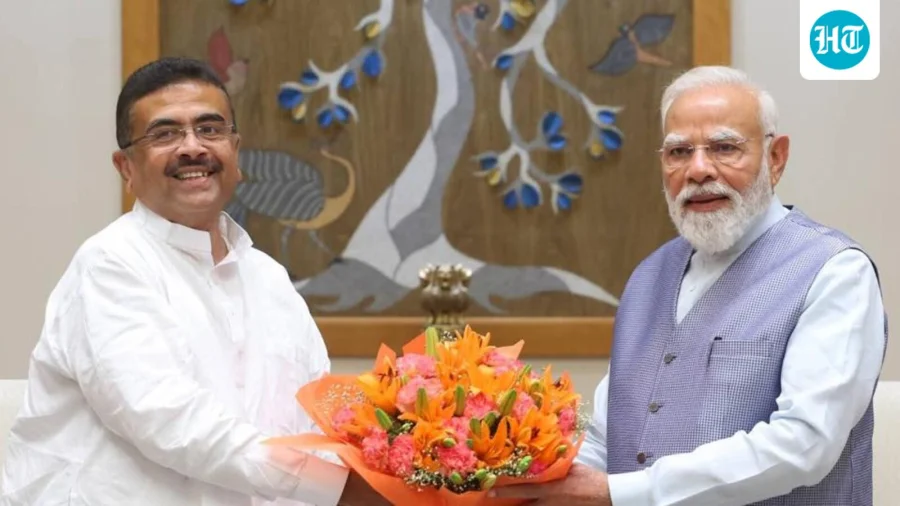
In a move that signals a dramatic shift in West Bengal’s political landscape, newly elected Chief Minister Suvendu Adhikari met Prime Minister Narendra Modi and President Droupadi Murmu in New Delhi on Friday — his first official visit to the capital after the BJP’s historic victory in the state. The meetings, held at the PM’s residence and Rashtrapati Bhavan, were more than just ceremonial. They marked the beginning of what both leaders described as a new era of “double-engine growth” for Bengal — a phrase that carries immense weight for millions of citizens hoping for faster development, better infrastructure, and transparent governance.
Bengal CM Meets PM Modi and President Murmu: A New Chapter Begins
West Bengal Chief Minister Suvendu Adhikari’s visit to New Delhi was his first official trip after the BJP’s landslide victory in the recent state elections. On Friday, he met President Droupadi Murmu at Rashtrapati Bhavan and Prime Minister Narendra Modi at the latter’s residence. The meetings were widely seen as a strong signal of the central government’s commitment to work closely with the new state administration.
According to sources, the discussions focused on key development projects, central assistance for Bengal, and the roadmap for implementing the BJP’s election promises. The phrase “double-engine growth” — referring to the combined power of a BJP government at both the Centre and the state — was a recurring theme.
Why This Matters Right Now
For the people of West Bengal, this meeting is not just political symbolism. It represents a tangible hope for change. After years of political friction between the state and central governments, the new alignment promises smoother fund flows, faster clearances for infrastructure projects, and a more coordinated approach to issues like industrial investment, job creation, and social welfare.
For investors and businesses, the message is clear: Bengal is now open for business with full central support. For ordinary citizens, it means the possibility of better roads, improved healthcare, and more efficient governance. The emotional weight of this meeting cannot be overstated — it is a moment of reconciliation and renewed optimism for a state that has often felt left behind.
How the Meetings Unfolded
The day began with CM Adhikari meeting President Droupadi Murmu at Rashtrapati Bhavan. The meeting was a formal courtesy call, but it also underscored the constitutional respect and continuity of democratic processes. Later, he proceeded to Prime Minister Modi’s residence for a more detailed working meeting.
During the meeting with PM Modi, the two leaders discussed a wide range of issues, including:
- Accelerating central infrastructure projects in Bengal
- Implementation of flagship central schemes like Ayushman Bharat and PM Awas Yojana
- Industrial investment and job creation
- Agricultural support and farmer welfare
- Law and order improvements
The meeting lasted over an hour, indicating the depth and seriousness of the discussions. Both leaders expressed optimism about the future.
Who Is Affected and What Officials Are Saying
The impact of this meeting will be felt across West Bengal’s 10 crore population. From farmers waiting for better prices to young job seekers hoping for industrial growth, the promise of “double-engine growth” touches every section of society.
Speaking after the meeting, CM Adhikari said, “Our government is committed to transparent governance and rapid development. With the full support of Prime Minister Modi and the central government, we will ensure that West Bengal reaches new heights of progress.”
PM Modi, in a social media post, described the meeting as “productive” and reiterated his government’s commitment to Bengal’s development. “Together, we will work for the prosperity of the people of West Bengal,” he wrote.
What We Know So Far — and What Remains Unclear
What we know:
- CM Adhikari met President Murmu and PM Modi on Friday in New Delhi
- The meetings focused on development, governance, and central-state cooperation
- Both leaders emphasized “double-engine growth” for Bengal
- The visit is CM Adhikari’s first official Delhi trip after the BJP’s win
What remains unclear:
- Specific timelines for major infrastructure projects
- Details of any new financial packages or central assistance announced
- The exact roadmap for implementing election promises
- How the new government will address long-standing issues like industrial land acquisition and bureaucratic hurdles
Risks, Concerns, and the Balanced View
While the mood is overwhelmingly positive, there are legitimate concerns that need to be addressed. Critics point out that “double-engine growth” has been a promise in other BJP-ruled states, but results have been mixed. Implementation challenges, bureaucratic inertia, and political opposition could slow down progress.
There are also questions about how the new government will handle West Bengal’s unique socio-political dynamics, including its strong regional identity and the legacy of previous administrations. Balancing development with cultural sensitivities will be a key challenge.
On the positive side, the BJP’s strong mandate gives the government a clear runway for reforms. The central government’s full support means that financial and technical resources are unlikely to be a constraint. The key will be execution.
Why Similar Trends Are Growing Across India
The concept of “double-engine growth” is not new. In states like Uttar Pradesh, Gujarat, and Madhya Pradesh, the presence of BJP governments at both the state and centre has led to faster project clearances, higher central investment, and improved governance metrics. West Bengal now joins this list, and the expectations are equally high.
This trend reflects a broader political realignment in India, where voters are increasingly rewarding parties that promise stable, coordinated governance. The message from Bengal’s electorate is clear: they want development, and they want it now.
“With the full support of Prime Minister Modi and the central government, we will ensure that West Bengal reaches new heights of progress.” — CM Suvendu Adhikari
What Readers, Citizens, and Investors Should Know Now
For ordinary citizens, this meeting is a positive sign. It means that the new government is serious about delivering on its promises. However, patience will be required — major changes take time to implement.
For investors and businesses, this is a strong signal to consider West Bengal as a destination for new projects. The state offers a large market, skilled workforce, and now, a business-friendly government with full central support.
For political observers, this visit cements the BJP’s dominance in Bengal and sets the stage for a new era of governance. The coming months will be crucial in determining whether the promises translate into tangible results.
What Could Happen Next
In the short term, we can expect a series of high-profile announcements related to infrastructure projects, industrial investments, and central scheme implementations. CM Adhikari is likely to hold follow-up meetings with various Union ministers to finalize details.
In the medium term, the focus will shift to execution. The state government will need to set up mechanisms for fast-tracking projects, improving ease of doing business, and ensuring that benefits reach the grassroots.
In the long term, the success of the “double-engine” model in Bengal could become a template for other states. If West Bengal achieves rapid, inclusive growth under the new dispensation, it could reshape India’s political and economic landscape.
Our Take: Why This Story Matters Beyond One Meeting
This is not just a story about a political meeting. It is a story about hope, change, and the power of democratic mandates. For years, West Bengal was seen as a state where development was held back by political conflict. That narrative is now being rewritten.
The meeting between CM Adhikari, PM Modi, and President Murmu is a powerful symbol of what is possible when different levels of government work together. It is a reminder that in a democracy, elections have consequences — and those consequences can be profoundly positive.
For the people of Bengal, this is a moment to be optimistic. But it is also a moment to hold their leaders accountable. The promises have been made. Now, the work begins.
FAQs
Why did Bengal CM Suvendu Adhikari meet PM Modi and President Murmu?
CM Adhikari met PM Modi and President Murmu as part of his first official visit to New Delhi after the BJP’s victory in West Bengal. The meetings focused on discussing development projects, central assistance, and the roadmap for “double-engine growth” — meaning coordinated governance between the state and central governments.
What is ‘double-engine growth’ for West Bengal?
‘Double-engine growth’ refers to the combined development momentum when the same party (BJP) is in power at both the state and central levels. It implies faster project approvals, better fund flow, and more efficient implementation of schemes. For Bengal, it promises accelerated infrastructure, industrial investment, and job creation.
What did CM Adhikari discuss with PM Modi?
During the meeting, CM Adhikari and PM Modi discussed accelerating central infrastructure projects in Bengal, implementing flagship schemes like Ayushman Bharat and PM Awas Yojana, boosting industrial investment, improving agriculture support, and enhancing law and order. The meeting lasted over an hour and was described as “productive.”
How will this meeting affect ordinary people in West Bengal?
For ordinary citizens, this meeting signals a new era of cooperation between the state and central governments. It could lead to faster development of roads, hospitals, schools, and other public infrastructure. It also means better implementation of welfare schemes, potentially improving the quality of life for millions of people across the state.