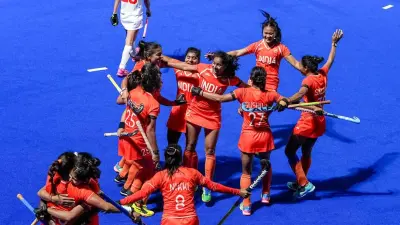
By the time the final whistle blew, the noise in Simdega had already started. Not in a stadium in Hangzhou — but on an Astroturf pitch in one of Jharkhand's smallest districts, where the news landed like a personal victory.
India's women's hockey team had just won Asian Games gold after 44 years. And for Simdega, it wasn't a distant national headline. It was a homecoming.
A Gold Medal That Belongs to Simdega as Much as to India
Four players from Jharkhand were part of the gold-winning squad. Three of them — captain Salima Tete, Beauty Dungdung and Deepika Soreng — come from Simdega district. Nikki Pradhan is from Khunti.
For a district that has quietly produced international hockey talent for years, the win felt less like an upset and more like overdue recognition.
Why a Small District in Jharkhand Is Celebrating Like It Won Itself
Simdega's relationship with hockey isn't new. The district has long been a feeder for state and national teams, with the Astroturf Hockey Stadium acting as its beating heart.
When three of your own are on the podium, the victory stops being abstract. It becomes proof — for every young girl in the district — that the path exists.
Mandar Drums, Tribal Songs and a Flag Held High
According to PTI, young players gathered at the Astroturf Hockey Stadium on Friday, waving the national flag and dancing to the beats of traditional mandar drums. They sang tribal folk songs — a celebration rooted in local culture, not staged ceremony.
It was a moment where national pride and tribal identity moved together, not in parallel.
The Captain, the Defender and the Names Simdega Will Now Remember
Salima Tete's rise from Simdega to captaining India is the kind of story that reshapes local ambition. Beauty Dungdung and Deepika Soreng add to a growing list of players from the region who have made it to the highest level.
For families in the district, these aren't just athletes. They're the reason a daughter might now be allowed to pick up a hockey stick instead of being told to focus only on studies.
What Officials and the Local Hockey Ecosystem Are Saying
Local reactions, as reported, centred on pride and the hope that this success translates into better facilities, coaching and opportunities in Jharkhand's hockey belt.
Officials and coaches in the region have repeatedly pointed to the district's talent pipeline. This gold medal gives that argument its strongest evidence yet.
Why This Win Matters Beyond the Medal Tally
India's last women's hockey gold at the Asian Games came 44 years ago. A generation of players came and went without touching that peak.
This squad didn't just end a drought. It reset expectations — for selection, for funding, and for how seriously women's hockey is treated in states like Jharkhand.
Confirmed Facts vs What Remains Unclear
Confirmed: India won women's hockey gold at the Asian Games after 44 years. Four Jharkhand players were in the squad — Salima Tete, Beauty Dungdung, Deepika Soreng and Nikki Pradhan. Celebrations took place in Simdega on Friday with flag-waving, mandar drums and tribal songs.
Unclear: Specific announcements on new infrastructure, cash awards or long-term development plans for Simdega's hockey ecosystem have not been detailed in the available report. Any claims about future funding should be treated as unconfirmed until officially stated.
The Risks of Celebrating Without Building
Gold medals generate headlines. They don't automatically generate Astroturf, coaches or nutrition programmes.
The real test for Simdega — and for Jharkhand — is whether this moment leads to sustained investment, or fades into a photo opportunity. History in Indian sport suggests the former is harder to secure than the latter.
A Pattern India Keeps Repeating — and Slowly Correcting
India's sporting success increasingly comes from small towns and tribal regions, not metros. Hockey in Jharkhand, athletics in Odisha, wrestling in Haryana — the map of Indian sport is shifting.
Simdega's celebration is part of that larger story: talent was never the problem. Access was.
What This Means for Young Players in Simdega Right Now
For a young girl training at the Astroturf stadium today, the distance between her and an Asian Games podium just became measurable — because someone from her district is standing on it.
For parents, coaches and local administrators, the message is simpler: the pipeline works. Protect it.
What Could Happen Next
Expect renewed calls for better hockey infrastructure in Jharkhand's tribal districts, and greater scrutiny of how state and central schemes reach these regions.
Whether that translates into action will depend on follow-through — not on the size of Friday's celebration.
Our Take
This isn't just a hockey story. It's a story about what happens when a region that has been producing talent for decades finally gets a national stage to prove it.
Simdega didn't celebrate someone else's win on Friday. It celebrated its own — and in doing so, quietly made the case for every small-town athlete still waiting for their turn.
Frequently Asked Questions
Which players from Jharkhand were part of India's Asian Games gold-winning women's hockey team?
Four players from Jharkhand were in the squad: captain Salima Tete, Beauty Dungdung and Deepika Soreng from Simdega district, and Nikki Pradhan from Khunti district.
How did Simdega celebrate the Asian Games hockey gold?
Young hockey players gathered at the Astroturf Hockey Stadium in Simdega, waved the national flag, danced to traditional mandar drums and sang tribal folk songs, according to PTI.
After how many years did India win women's hockey gold at the Asian Games?
India's women's hockey team won Asian Games gold after 44 years, ending a long wait for the title.
Why is Simdega's celebration significant for Indian hockey?
Simdega has long been a talent hub for hockey in Jharkhand. With three players from the district in the gold-winning squad, the win strengthens the case for better infrastructure, coaching and funding in the region's tribal belt.