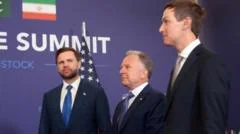
The United States and Iran have begun direct talks in Switzerland, a rare and high-stakes diplomatic engagement, even as Tehran’s military claims it has closed the strategically vital Strait of Hormuz. The move, which Washington has disputed, sets a volatile stage for negotiations that could shape the trajectory of Middle East tensions.
Why the Strait of Hormuz closure claim matters now
The Strait of Hormuz is a narrow chokepoint connecting the Persian Gulf to the open ocean. Roughly 20% of the world’s oil passes through it daily. Any disruption, even a disputed one, sends immediate shockwaves through global energy markets. Iran’s claim, attributed to the Islamic Revolutionary Guard Corps (IRGC), is a direct escalation tied to ongoing Israeli military operations in Lebanon. The IRGC has warned vessels to stay away, though the US insists the waterway remains open to navigation.
How the talks and the closure are connected
The timing is no coincidence. Iran’s closure claim appears designed to increase its leverage just as negotiators sit down in Switzerland. By raising the specter of a blocked strait, Tehran signals it is willing to risk a broader confrontation if its demands are not met. The US, by publicly disputing the closure, is attempting to neutralize that leverage and project calm. The talks themselves are focused on broader regional issues, including Iran’s nuclear program and its support for proxy groups, but the strait issue now dominates the agenda.
What the Iranian Revolutionary Guard has said
The IRGC has stated that the Strait of Hormuz is closed to shipping in response to what it describes as Israeli attacks in Lebanon. The exact nature of these attacks and the legal basis for the closure remain unclear. The IRGC’s statement is a significant escalation, as it directly threatens a waterway that is critical to global trade. The US has not provided evidence to contradict the claim but has firmly stated that the strait remains open, suggesting it does not recognize Iran’s authority to enforce such a closure.
Who is affected by a potential Strait of Hormuz closure
The immediate impact would be felt by oil tankers and commercial shipping, but the ripple effects would reach every corner of the global economy. Higher oil prices, increased insurance costs for vessels, and potential supply chain delays are all possible. For India, which imports a significant portion of its crude oil from the Gulf region, any disruption would directly impact fuel prices and the broader economy. The situation also threatens the stability of Gulf states like Saudi Arabia, the UAE, and Qatar, whose oil exports depend on the strait.
Washington’s response: disputed claim, firm stance
The Biden administration has moved quickly to counter Iran’s narrative. US officials have stated that the Strait of Hormuz remains open and that they are monitoring the situation closely. The US Navy’s Fifth Fleet, based in Bahrain, is capable of ensuring freedom of navigation. By disputing the closure, Washington is attempting to prevent a self-fulfilling prophecy where the mere claim of a closure causes shipping companies to avoid the strait. The US is also likely using the Switzerland talks to press Iran to retract the threat.
What the Switzerland talks mean for the region
The talks in Switzerland represent a rare direct channel between Washington and Tehran, which have not had formal diplomatic relations for decades. The discussions are expected to cover a range of issues, including Iran’s nuclear program, its ballistic missile development, and its support for groups like Hezbollah and Hamas. The strait closure claim adds a new, urgent dimension. The success or failure of these talks could determine whether the region slides into a wider conflict or finds a path toward de-escalation.
Confirmed facts vs what remains unclear
What is confirmed: The US and Iran have begun talks in Switzerland. The IRGC has claimed it has closed the Strait of Hormuz and warned vessels away. The US has publicly disputed this claim. What remains unclear: The exact legal or military mechanism by which Iran could enforce a closure. Whether any vessels have actually been prevented from transiting. The specific Israeli actions in Lebanon that Iran cites as justification. The full agenda and progress of the Switzerland talks.
Risks and the potential for miscalculation
The situation carries significant risks. A miscalculation by either side could lead to a direct military confrontation in the strait. Iran’s history of using the waterway as a bargaining chip, including during the Iran-Iraq war, shows it is willing to follow through on threats. However, a full closure would also hurt Iran’s own economy, as it relies on the strait for its oil exports. The US must balance a firm response with avoiding an escalation that could draw it into a broader conflict. The talks in Switzerland are the best hope for a diplomatic off-ramp.
Wider pattern: Iran’s use of the strait as leverage
This is not the first time Iran has threatened to close the Strait of Hormuz. During the 2019 tanker attacks and the 2020 US drone strike that killed General Qasem Soleimani, Tehran made similar threats. The pattern is clear: when Iran feels cornered or wants to increase its negotiating power, it weaponizes the strait. The current situation fits this pattern, with the added complexity of the Israel-Lebanon conflict. The international community’s response has historically been to maintain freedom of navigation through naval presence and diplomatic pressure.
What this means for global oil prices and markets
Oil prices are likely to remain volatile as long as the strait closure claim is in dispute. Traders will price in a risk premium, even if the waterway remains open. If the situation escalates, prices could spike sharply. For consumers, this means higher petrol and diesel prices are a real possibility. The US and other major economies have strategic petroleum reserves that could be tapped to stabilize markets, but the psychological impact of a threatened closure is already being felt.
What should readers and investors do now
For the general public, the key is to stay informed but avoid panic. The situation is fluid, and official statements from both governments should be treated with caution. For investors, particularly those with exposure to oil and gas, it is a time to monitor developments closely. Diversification and hedging strategies may be prudent. For anyone directly involved in shipping or logistics, contingency planning for alternative routes and higher costs is advisable.
Future outlook: what could happen next
The most likely near-term scenario is a period of heightened tension followed by a de-escalation if the Switzerland talks produce any tangible progress. If talks fail, Iran may attempt to enforce the closure more aggressively, leading to a potential naval confrontation. A less likely but more dangerous scenario is a direct US-Iran military clash. The best-case outcome is a diplomatic agreement that addresses both the strait issue and the broader regional tensions. The next 48 to 72 hours will be critical.
Our Take
This is a classic example of brinkmanship. Iran is using its most powerful geographic weapon — control over the Strait of Hormuz — to force the US to take its concerns seriously. The US, by disputing the claim, is trying to deny Iran that leverage. The real story is not whether the strait is actually closed, but that the threat alone is enough to destabilize global markets and raise the risk of conflict. The Switzerland talks are now the most important diplomatic event in the Middle East. Their success or failure will determine whether this is a temporary spike in tension or the beginning of a much wider crisis.
Frequently Asked Questions
Is the Strait of Hormuz actually closed?
Iran’s military claims it has closed the strait, but the United States disputes this and says the waterway remains open to navigation. It is unclear if any vessels have been prevented from transiting.
Why is the Strait of Hormuz so important?
It is a narrow chokepoint through which about 20% of the world’s oil passes. Any disruption can cause global oil prices to spike and affect economies worldwide.
What are the US-Iran talks in Switzerland about?
The talks cover a range of issues including Iran’s nuclear program, regional tensions, and now the Strait of Hormuz closure claim. They are a rare direct diplomatic channel between the two countries.
What should I do if oil prices rise due to this?
Monitor fuel prices and consider adjusting your budget. For investors, it may be a time to review exposure to oil and gas sectors. Avoid panic buying.