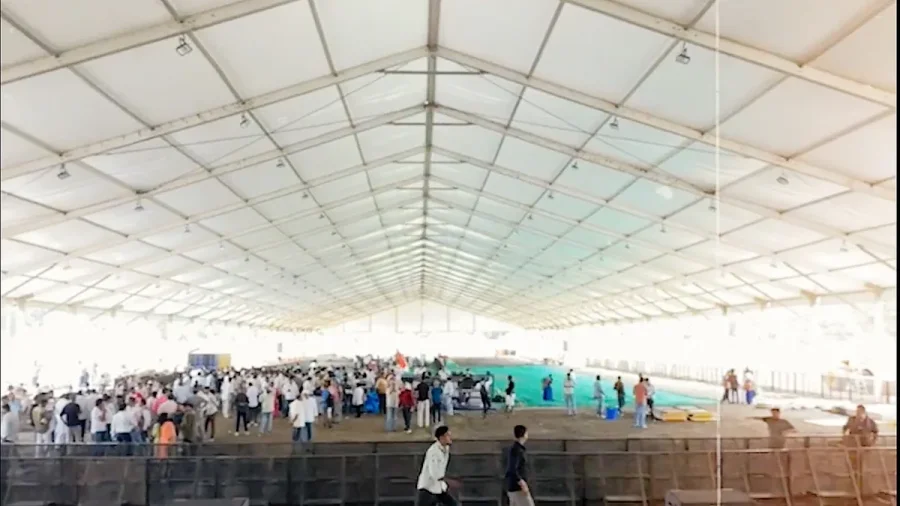
Late on Friday evening, Congress MP Pawan Khera released a single sheet of paper that told a story bigger than one event. It listed the latest condition Indore Police had added to a growing stack of 31 requirements for Rahul Gandhi's student outreach programme, 'Chhatron Ki Goonj'. Among them: coaching institutes must submit a written undertaking that students attending the event do so at their own risk.
The condition is not just administrative. It shifts legal and moral responsibility onto the very institutions the event is designed to engage. And it raises a question that goes beyond Indore: is this about security, or is it about making the event too costly to host?
A Student Dialogue That Keeps Running Into Paperwork
'Chhatron Ki Goonj' was conceived as a direct conversation between Rahul Gandhi and students. It has already travelled to Kota, Dehradun, Prayagraj, and Pune. Each stop has drawn large crowds, mostly young people preparing for competitive exams or navigating the early years of college.
Indore was meant to be the fifth edition. Instead, it has become the latest example of what Congress leaders describe as a deliberate pattern of obstruction. The 31 conditions reportedly cover everything from venue timing and crowd size to security deposits and now, institutional liability.
Why a Written Undertaking Changes the Equation
Coaching institutes in Indore are not political entities. They are businesses with reputations to protect and parents to answer to. Asking them to sign a document accepting responsibility for students who attend a political event puts them in an uncomfortable position.
If they sign, they risk being seen as endorsing the event. If they refuse, the event may not get the clearance it needs. Either way, the burden shifts from the police to private institutions. Critics argue this is a subtle but effective way to shrink the audience without issuing a formal ban.
How the Conditions Accumulated
According to Khera's statement, the conditions were not released all at once. They were added incrementally over the days leading up to the event. This piecemeal approach, Congress leaders say, made it difficult to plan logistics or challenge the requirements in time.
The final condition, released on Friday evening, came less than 24 hours before the scheduled event on Saturday. That timing left organisers with almost no room to negotiate or comply fully.
What This Means for Students in Indore
For students who were planning to attend, the uncertainty is real. Many had arranged travel, adjusted coaching schedules, or informed families. The last-minute condition means they may not know until the final hours whether the event will happen at all.
It also sends a signal. If attending a political dialogue requires an institutional undertaking, students may think twice before showing up next time. The chilling effect is not legal, but it is practical.
Congress's Response and the Emerging Template
Pawan Khera's decision to publicly release the condition was itself a political move. By putting the document in the public domain, the Congress is trying to frame the issue as one of democratic access, not party politics.
Party leaders have pointed out that similar hurdles appeared in earlier cities. In Kota, organisers faced last-minute venue changes. In Pune, permissions were delayed. The Indore conditions, they argue, are the most explicit version of a template that is still being written.
What Is Confirmed and What Is Still Unclear
Confirmed: Indore Police issued 31 conditions for the event. One condition requires coaching institutes to submit a written undertaking. Pawan Khera released this information publicly on Friday evening.
Unclear: Whether the event proceeded as scheduled on Saturday. Whether coaching institutes agreed to sign the undertaking. Whether the Congress formally challenged the conditions in court or before an administrative authority. Whether similar conditions will be applied to future editions in other cities.
Any speculation about the police's intent should be treated as exactly that — speculation. The official rationale for the conditions has not been fully detailed in public statements.
The Bigger Pattern: Permission as a Political Tool
Across India, political events of all stripes face regulatory conditions. The question is not whether conditions are imposed, but whether they are proportionate, consistent, and applied without partisan bias.
When conditions multiply at the last minute, they cease to be safety measures and become gatekeeping mechanisms. That is the concern Congress is raising. It is a concern that applies regardless of which party is in power.
What Students and Organisers Should Watch For
If you are a student planning to attend a similar event in another city, expect tighter requirements. Keep an eye on official police notifications and venue announcements. If you are part of a coaching institute asked to sign an undertaking, seek legal clarity before doing so.
For political organisers, the lesson is to build in more lead time for permissions and to document every condition received. Public transparency is the strongest counter to administrative opacity.
What Could Happen Next
The Congress has signalled it will continue the series. If the Indore event goes ahead under these conditions, it may set a precedent for other cities. If it does not, the party is likely to escalate the issue politically.
Either way, the 31 conditions will be cited in future debates about the space available for political dialogue in India. The story is no longer just about one event in one city.
Our Take
The Indore conditions matter because they test a simple principle: can a political leader meet students without jumping through 31 hoops? The answer will shape how opposition outreach is conducted across the country. It is not a partisan question. It is a question about the health of public discourse itself.
Frequently Asked Questions
What is 'Chhatron Ki Goonj'?
It is a student outreach programme led by Rahul Gandhi, designed as a direct dialogue between the Congress leader and students. It has been held in Kota, Dehradun, Prayagraj, and Pune, with Indore as the planned fifth stop.
What are the 31 conditions imposed by Indore Police?
The conditions reportedly cover venue timing, crowd management, security arrangements, and a new requirement that coaching institutes submit a written undertaking accepting responsibility for students who attend. The full list has not been officially published by the police.
Why did Congress release the conditions publicly?
Congress MP Pawan Khera released the latest condition to highlight what the party calls a pattern of administrative obstruction. Public disclosure puts pressure on authorities and informs students and organisers about the hurdles involved.
Did the Indore event take place as scheduled?
At the time of writing, it is unclear whether the event proceeded on Saturday evening. The last-minute nature of the final condition left organisers with limited time to comply or respond.