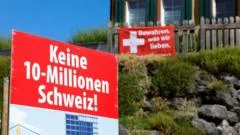
Switzerland has spoken — and the answer is no to a population cap. In a decisive referendum on Sunday, nearly 55% of Swiss voters rejected a proposal to limit the country’s population to 10 million by slashing immigration. The result is a clear endorsement of the status quo, even as concerns about housing, infrastructure, and national identity simmer beneath the surface.
What the 10 million population cap proposal would have done
The initiative, championed by the right-wing Swiss People’s Party (SVP), sought to amend the constitution to cap the population at 10 million. If the population approached that threshold, the government would have been required to cut net migration to zero — effectively ending Switzerland’s long-standing policy of open borders, particularly with the European Union. The SVP argued that unchecked growth was straining public services, driving up rents, and eroding Swiss culture.
Why Swiss voters said no — the economic argument wins
Opponents of the cap, including the Swiss government, major business groups, and most political parties, warned that the measure would devastate the economy. Switzerland relies heavily on foreign workers, especially in healthcare, technology, and construction. A sudden halt to immigration, they argued, would trigger labour shortages, slow growth, and damage Switzerland’s reputation as a hub for international talent. The "No" campaign framed the vote as a choice between prosperity and isolation — and voters chose prosperity.
The SVP’s campaign: fear of overcrowding vs. economic reality
The SVP ran a characteristically aggressive campaign, using imagery of crowded trains and housing shortages to stoke anxiety about population growth. "Our country is full," was a recurring slogan. But the message failed to resonate beyond the party’s base. Analysts say the SVP overestimated public appetite for radical change, especially when the economic consequences were laid out so starkly. The result also reflects a broader Swiss pragmatism — a reluctance to disrupt a system that has delivered stability and wealth.
Who is affected by the rejection of the population cap?
The immediate beneficiaries are the hundreds of thousands of EU citizens living and working in Switzerland, as well as Swiss businesses that depend on cross-border labour. The vote also reassures Switzerland’s neighbours — particularly Germany, France, and Italy — that Bern will not unilaterally tear up bilateral agreements on free movement. For ordinary Swiss residents, the result means no sudden policy shift, but the underlying pressures of population growth — housing shortages, rising rents, and crowded public transport — remain unresolved.
Swiss government and EU reaction to the referendum result
The Swiss government welcomed the outcome, with Interior Minister Elisabeth Baume-Schneider calling it "a vote for openness and economic common sense." The European Commission, which had watched the vote closely, expressed relief. A spokesperson said the result "affirms the shared commitment to the principles of free movement that underpin EU-Swiss relations." The SVP, meanwhile, acknowledged defeat but vowed to continue pushing for stricter immigration controls through other channels.
Why the population cap vote matters beyond Switzerland
This referendum is being watched across Europe as a bellwether for immigration politics. In an era of rising populism and anti-immigrant sentiment, Switzerland — a country where direct democracy gives citizens the final word — has chosen restraint over restriction. The result suggests that even in nations where immigration is a hot-button issue, voters can still be swayed by economic arguments and a desire for stability. It also highlights the limits of populist messaging when confronted with concrete trade-offs.
Confirmed facts vs what remains unclear after the vote
Confirmed: 55% voted against the cap; turnout was around 48%; the SVP-backed initiative failed in all but a handful of rural cantons; the government had officially opposed the measure. Unclear: Whether the SVP will now push for a new, more narrowly targeted immigration initiative; how the government plans to address housing and infrastructure pressures without a cap; and whether public sentiment on immigration will shift if population growth accelerates.
Switzerland’s direct democracy: how the system works
Switzerland’s unique system of direct democracy allows any group to force a national vote on a constitutional amendment if it gathers 100,000 signatures. This was the SVP’s latest attempt to use that mechanism to reshape immigration policy. The system ensures that major policy changes require popular consent, but it also means that controversial ideas — like a population cap — get a public hearing. Sunday’s result shows that the system can also serve as a check on populist overreach.
Risks and balanced view: what critics of the "No" vote say
Not everyone is celebrating. Supporters of the cap argue that the "No" vote ignores genuine public anxiety about quality of life. They point to rising rents in Zurich and Geneva, overcrowded schools, and the strain on healthcare as evidence that unchecked growth has real costs. Some critics also warn that the result could embolden the political establishment to ignore grassroots concerns about immigration. The SVP has already signalled that it will use the vote to rally its base ahead of federal elections next year.
The wider trend: immigration referendums across Europe
Switzerland is not alone in putting immigration to a popular vote. In recent years, similar referendums have been held in Hungary, Poland, and the Netherlands, though with varying outcomes. What sets Switzerland apart is the binding nature of its referendums and the country’s deep integration with the EU labour market. The result here could influence how other European governments approach immigration policy — particularly in countries where populist parties are gaining ground.
What Swiss residents and businesses should do now
For Swiss businesses, the vote removes a major source of uncertainty. Companies can continue to recruit foreign talent without fear of sudden restrictions. For residents concerned about housing and infrastructure, the onus now shifts to local and federal governments to address these issues through policy, not population caps. For EU citizens living in Switzerland, the result offers reassurance that their status remains secure — at least for now.
What happens next: the future of Swiss immigration policy
The government is expected to focus on incremental measures to manage growth — such as increasing housing supply, investing in public transport, and improving integration programmes. The SVP, meanwhile, is likely to regroup and may launch a new initiative targeting specific aspects of immigration, such as family reunification or asylum policy. The broader debate about Switzerland’s identity and capacity for growth is far from over.
Our Take
This referendum was a stress test for Swiss democracy — and it passed. The rejection of the population cap shows that when voters are presented with a clear choice between economic pragmatism and populist restriction, they often choose the former. But the narrowness of the debate — cap or no cap — obscured the real issue: how to manage growth in a way that preserves quality of life without closing the door to the world. That challenge remains. For now, Switzerland has chosen openness. The hard work of making that openness sustainable lies ahead.
Frequently Asked Questions
What was the Swiss 10 million population cap proposal?
The initiative, backed by the right-wing Swiss People’s Party (SVP), sought to amend the constitution to limit Switzerland’s population to 10 million. If the population approached that threshold, the government would have been required to cut net migration to zero.
Why did Swiss voters reject the population cap?
Nearly 55% voted against the proposal, primarily due to economic concerns. Opponents argued that cutting immigration would cause labour shortages, harm the economy, and damage Switzerland’s relationship with the European Union.
What does the result mean for EU citizens in Switzerland?
The rejection of the cap means that current free movement agreements with the EU remain intact. EU citizens living and working in Switzerland can continue to do so without immediate risk of policy changes.
Will the Swiss People’s Party try again with a new immigration initiative?
It is likely. The SVP has a history of launching multiple initiatives on immigration. While this attempt failed, the party may introduce a more narrowly targeted proposal in the future, possibly focusing on asylum or family reunification.