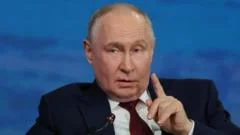
Russian President Vladimir Putin has shut the door on any immediate diplomatic breakthrough with Ukraine, declaring there is "no point" in meeting President Volodymyr Zelenskyy to end the war. The blunt dismissal came just days after Zelenskyy wrote an unprecedented open letter to Putin — his first public message to the Russian leader since the full-scale invasion began in February 2022 — proposing face-to-face talks.
Putin calls Zelenskyy's letter 'boorish' and 'rude'
Speaking at the St. Petersburg International Economic Forum on Thursday, Putin did not mince words. He described Zelenskyy's letter as "boorish" and said it was not a serious basis for negotiations. "Is it a way to create conditions for personal meetings and talks, or create an environment where there is no point in meeting?" Putin asked rhetorically, according to reports from the forum. "There is no point."
Why this kills hopes for a ceasefire breakthrough
The rejection is significant because it comes at a moment when international mediators — including Turkey, Saudi Arabia, and the Vatican — have been pushing for a renewed diplomatic track. Zelenskyy's open letter was seen by some as a rare olive branch, a direct appeal to Putin to sit down and negotiate an end to a war that has killed tens of thousands and displaced millions. Putin's response signals that Moscow sees no value in talks unless Kyiv first accepts Russian terms.
How the exchange unfolded: from open letter to public rejection
Zelenskyy's letter, which was published on his official website and shared widely on social media, criticized Putin's 26 years in power and suggested that "age is beginning to take its toll" on the Russian leader. It called for a meeting to discuss ending the war. Putin, appearing visibly irritated at the economic forum, said the letter was "rude" and that such language was unacceptable for a leader seeking dialogue. The exchange marks one of the most direct and personal confrontations between the two leaders since the war began.
Who is affected: ordinary Ukrainians and Russians bear the cost
For ordinary Ukrainians, Putin's rejection means more months — or years — of war. Air raid sirens continue to sound daily across Ukrainian cities. Power grids are under strain. Families remain separated. For Russians, the war has brought economic isolation, inflation, and the loss of tens of thousands of soldiers. The diplomatic deadlock means neither side sees a way out, and the human cost continues to mount.
Kremlin's official position: peace talks first, ceasefire later
The Kremlin has consistently maintained that any ceasefire must be preceded by comprehensive peace talks that address Russia's core demands — including Ukraine's neutrality, recognition of annexed territories, and demilitarization. Zelenskyy's position is the opposite: he insists on an immediate ceasefire and withdrawal of Russian troops as a precondition for any political negotiations. This fundamental disagreement remains the central obstacle to any diplomatic progress.
What Putin's rejection really means for the war's trajectory
Putin's refusal to meet Zelenskyy is not just a diplomatic snub — it is a strategic signal. By publicly rejecting the offer, Putin is telling both domestic and international audiences that he sees no urgency in ending the war on terms that do not favor Moscow. It also reinforces the narrative that Russia is prepared for a long war of attrition. For Ukraine, it confirms that diplomacy through direct presidential contact is currently a dead end.
Confirmed facts vs what remains unclear
Confirmed: Putin said there is "no point" meeting Zelenskyy. He called Zelenskyy's letter "boorish." Zelenskyy wrote an open letter proposing talks. Putin spoke at the St. Petersburg International Economic Forum on June 5, 2026. Unclear: Whether any backchannel communications exist between the two sides. Whether international mediators can still arrange a meeting despite Putin's public rejection. Whether Zelenskyy will respond with another diplomatic overture or escalate military operations.
Why Putin's stance matters for global diplomacy
The rejection comes at a time when the Global South — including India, China, Brazil, and South Africa — has been calling for a negotiated settlement. India, in particular, has maintained a neutral stance and urged both sides to return to dialogue. Putin's refusal complicates these efforts, as it suggests Russia is not yet ready for a compromise. It also puts pressure on Western allies to continue military and financial support for Ukraine, as diplomatic options narrow.
Risks and balanced view: is there any path to talks?
Some analysts argue that Putin's rejection is partly performative — designed to strengthen his domestic position ahead of any future negotiations. Others believe the war has reached a stage where neither leader can afford to appear weak. Zelenskyy's letter, while bold, may have been seen by Moscow as a provocation rather than an invitation. The risk is that both sides become more entrenched, making any future ceasefire even harder to achieve.
Wider trend: the personalization of the Ukraine-Russia conflict
This exchange reflects a broader pattern in the war: the conflict has become deeply personal between Putin and Zelenskyy. Both leaders have used direct addresses, social media, and public letters to frame the war as a struggle between two men and two visions. This personalization makes diplomacy harder, as any concession can be framed as a personal defeat. It also raises the stakes for any future meeting, which would carry enormous symbolic weight.
What Ukrainians and Russians should watch for next
For those following the war, the key indicators to watch are: whether international mediators like Turkey or Saudi Arabia attempt to arrange a meeting despite Putin's rejection; whether Zelenskyy responds with another diplomatic initiative or shifts to a more aggressive military posture; and whether Russia signals any willingness to negotiate through backchannels. For now, the public stance from both sides remains unchanged.
Future outlook: no quick end in sight
Without direct talks between Putin and Zelenskyy, the war is likely to continue at its current intensity through 2026 and into 2027. Both sides are preparing for a long conflict. Ukraine continues to receive Western weapons and financial aid. Russia is ramping up its own military production and seeking support from China, Iran, and North Korea. A diplomatic breakthrough appears distant, barring a major shift on the battlefield or a change in leadership in either country.
Our Take
Putin's rejection of Zelenskyy's meeting offer is a sobering reminder that this war is far from over. While Zelenskyy's open letter was a bold diplomatic move, it was always a long shot. Putin has shown no interest in negotiating on anything less than his maximalist terms. The tragedy is that ordinary people — in Ukraine, in Russia, and around the world — continue to pay the price for this deadlock. Diplomacy is not dead, but it is on life support. The next move belongs to the mediators, not the leaders.
Frequently Asked Questions
Why did Putin reject meeting Zelenskyy?
Putin said there is "no point" meeting Zelenskyy because he described the Ukrainian president's open letter proposing talks as "boorish" and "rude." He also reiterated that peace talks must come before any ceasefire, while Zelenskyy demands a ceasefire first.
What did Zelenskyy write in his open letter to Putin?
Zelenskyy wrote a public letter criticizing Putin's 26 years in power and suggesting that "age is beginning to take its toll" on the Russian leader. He called for a face-to-face meeting to discuss ending the war.
Can international mediators still arrange a meeting between Putin and Zelenskyy?
It is unlikely in the near term. Putin's public rejection makes it difficult for mediators to arrange a meeting without a significant shift in Russia's position. However, backchannel efforts may continue.
What are the main obstacles to peace talks between Russia and Ukraine?
The main obstacle is the fundamental disagreement over sequencing: Russia wants peace talks before a ceasefire, while Ukraine demands a ceasefire and troop withdrawal before any political negotiations. Both sides also have incompatible territorial demands.