

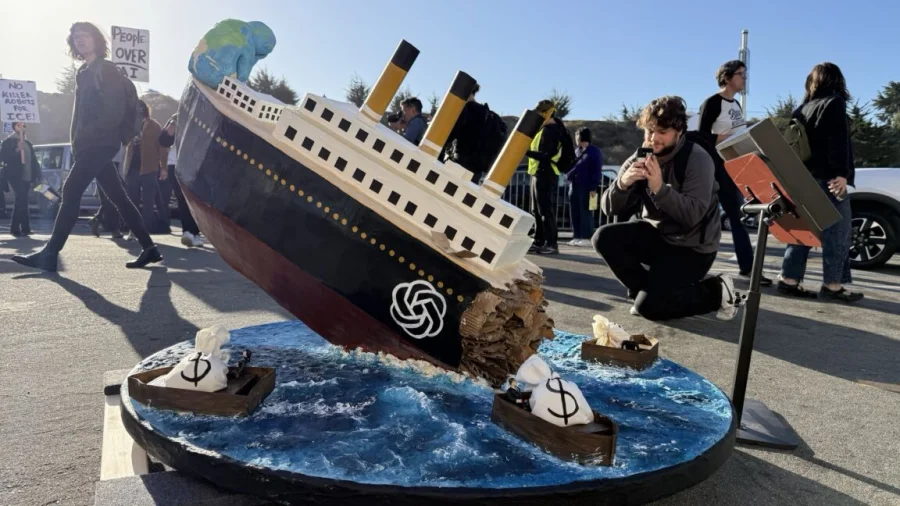
On a sidewalk in San Francisco, a five-foot papier-mâché ship tilts dangerously. Tiny figures in suits scramble toward a lifeboat, clutching bags of gold. Below deck, smaller, faceless shapes wait as water rises. This is "What Iceberg?" — and it is not a gallery piece. It sat Tuesday at the public entrance to an OpenAI developer event, built to be seen by the very industry it critiques.
A Ship Built in Five Days, Aimed at the AI Boom
The installation was created by two artists from Odd Friend Studio, a Berkeley-based collective. One co-creator, who gave his name only as "Kevin," said the team spent five days constructing the piece from papier-mâché, cardboard, paint, and a repurposed table.
According to the artists' own description, the sculpture "shows OpenAI's leaders and investors escaping a sinking ship with unimaginable wealth, while everyone else is left to face the cost of AI."
Why a Sinking Ship Resonates Beyond the Art World
The metaphor lands because it mirrors a growing public anxiety: that the people building artificial intelligence will capture its rewards, while workers, artists, and ordinary users absorb the disruption.
That fear is not abstract. It shows up in debates over job displacement, copyright, energy consumption, and the concentration of AI power in a handful of companies. The sculpture turns those debates into something you can see in ten seconds.
From Angry Signs to Crafted Narratives
Protests against AI companies have often taken the form of open letters, boycotts, or picket signs. "What Iceberg?" represents a different approach — slower, more deliberate, and visually compelling.
The artists did not shout. They built. And in doing so, they created an image that travels further than a slogan.
Who Feels the Weight of This Message
The piece speaks to several groups at once. Artists and writers who worry their work is being used to train models without consent. Entry-level workers who see automation creeping into their roles. And everyday users who benefit from AI tools but wonder who ultimately pays the price.
For OpenAI, the installation is a reminder that its public image is no longer shaped only by product launches. It is also shaped by the people who show up outside.
No Official Response, No Clear Next Step
OpenAI has not issued a public statement about the installation. It is also unclear whether Odd Friend Studio plans to display "What Iceberg?" elsewhere or build similar pieces for future AI events.
What is clear is that the sculpture was designed for a specific moment — and it found one.
What the Sculpture Gets Right — and What It Leaves Out
The piece captures a real tension: AI development is concentrated among a few companies, and the financial upside is enormous. But the metaphor of a sinking ship simplifies a more complicated reality.
AI also creates jobs, improves medical diagnostics, and expands access to education. The question is not whether the ship sinks — it is who gets to steer it, and who gets a lifeboat.
A Pattern of Creative Resistance
"What Iceberg?" is part of a broader trend. Across the Bay Area and beyond, critics of AI are moving from petitions to performances, from op-eds to objects. The goal is not just to argue — it is to make the argument impossible to ignore.
Whether this approach changes corporate behavior is uncertain. But it changes the conversation.
What This Means for Readers Watching the AI Debate
If you follow AI news, expect more of this. As AI companies hold more developer events, product launches, and conferences, they will also attract more creative counter-narratives.
For students, workers, and investors, the takeaway is simple: the public conversation around AI is widening. It is no longer just about what the technology can do — it is about who it serves.
What Could Happen Next
Odd Friend Studio has not announced future plans. OpenAI has not commented. But the installation has already done what it set out to do: it made people stop, look, and ask who is on the lifeboat.
Our Take
"What Iceberg?" is not a policy paper. It is a piece of street theater with a sharp point. Its power lies in its simplicity — a ship, a lifeboat, a gap between those who escape and those who remain.
Whether you agree with its message or not, it signals something important: the debate over AI is maturing. It is moving from technical circles into public space, where art can say what press releases cannot.
Frequently Asked Questions
What is the "What Iceberg?" sculpture?
It is a five-foot papier-mâché installation created by Odd Friend Studio that depicts OpenAI leaders and investors escaping a sinking ship with wealth while others face the cost of AI.
Where was the OpenAI protest sculpture displayed?
It was placed at the public entrance to an OpenAI developer event in San Francisco on Tuesday.
Who created the installation?
Two artists from Odd Friend Studio, a Berkeley-based collective. One co-creator identified himself only as "Kevin."
Did OpenAI respond to the sculpture?
No official response from OpenAI has been reported.