
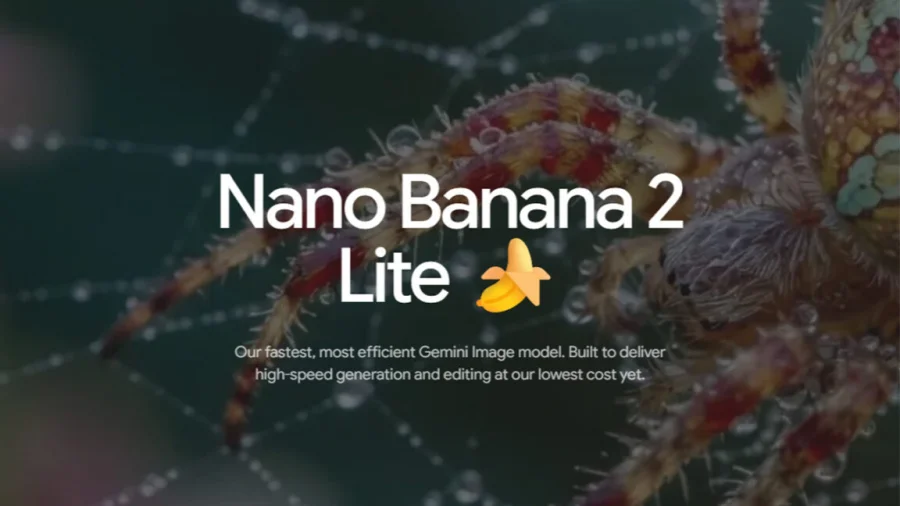
The race for faster, cheaper AI image generation just got a new leader. Google DeepMind has quietly launched Nano Banana 2 Lite, a model that promises to slash both time and cost without completely sacrificing quality. For millions of creators, designers, and businesses who rely on AI visuals, this could change how quickly ideas become images.
What Makes Nano Banana 2 Lite Different?
Nano Banana 2 Lite, technically named Gemini 3.1 Flash Lite Image, is part of Google’s latest Gemini 3.1 family. Unlike its more powerful siblings, this model is engineered for speed. Google says it creates images in a fraction of the time taken by its beefier models, making it ideal for rapid-fire prototyping and exploring ideas quickly.
The key trade-off? Quality can take a backseat. But Google has provided examples showing how close Nano Banana 2 Lite can get to the quality of its other image models, suggesting the gap may be narrower than expected.
Why Speed and Cost Matter Right Now
For most users, the biggest barrier to using AI image generation isn’t capability — it’s cost and waiting time. High-quality models often require significant compute resources, translating to higher prices and slower outputs. Nano Banana 2 Lite directly addresses this pain point. By offering a faster, cheaper alternative, Google is making AI image generation accessible to a broader audience, including small businesses, freelancers, and individual creators who may not have the budget for premium models.
This move could democratize rapid visual prototyping, allowing users to iterate on ideas without worrying about mounting costs or delays.
How It Fits Into Google’s AI Ecosystem
Nano Banana 2 Lite is available today across the Google ecosystem, including Gemini and other platforms. It’s part of a broader strategy to offer tiered AI capabilities — from ultra-fast, low-cost models for quick tasks to premium models for high-fidelity outputs. This approach mirrors what we’ve seen in text-based AI models, where speed and cost tiers allow users to choose based on their specific needs.
Google DeepMind’s focus on balancing speed, cost, and quality suggests they’re targeting a sweet spot in the market: users who need good-enough quality quickly and cheaply.
Who Benefits Most from This Model?
The primary audience is anyone involved in rapid prototyping or idea exploration. Designers can quickly generate visual concepts, marketers can test ad creatives, and educators can create illustrative materials without waiting for slower models. Even hobbyists exploring AI art will find the lower cost barrier appealing.
However, for projects requiring photorealistic detail or complex compositions, Google’s more powerful models remain the better choice. Nano Banana 2 Lite is about speed and iteration, not final production quality.
Google DeepMind’s Official Position
Google DeepMind has positioned Nano Banana 2 Lite as a tool for exploration. “This model is ideal for exploring ideas and rapid-fire prototyping,” the company stated. They emphasize that while quality can take a backseat in these use cases, the model still delivers impressive results. The examples provided aim to demonstrate how close it can get to the quality of their other image models, suggesting confidence in its capabilities.
What the Quality-Speed Trade-Off Really Means
In practice, the trade-off means that Nano Banana 2 Lite may produce images that are slightly less detailed or have minor artifacts compared to premium models. But for many use cases — like brainstorming visual concepts, generating placeholder images, or creating social media graphics — this difference may be negligible. The real value lies in the ability to generate multiple iterations quickly, enabling faster decision-making and creativity.
Confirmed Facts vs What Remains Unclear
Confirmed: Nano Banana 2 Lite is part of the Gemini 3.1 family, available today, and designed for speed and affordability. Google has provided quality comparison examples.
Unclear: Exact pricing details, specific speed benchmarks compared to competitors, and precise quality metrics remain undisclosed. Independent testing will be needed to verify Google’s claims.
Google’s Moat: Ecosystem Integration and Scale
Google’s advantage with Nano Banana 2 Lite isn’t just the model itself — it’s the ecosystem. Integration with Gemini, Google Cloud, and other platforms means users can access the model without switching tools. This network effect, combined with Google’s massive compute infrastructure, allows them to offer competitive pricing that smaller players may struggle to match.
Risks and Balanced View
While Nano Banana 2 Lite offers speed and cost benefits, there are risks. The quality trade-off may disappoint users expecting flagship-level outputs. Additionally, reliance on Google’s ecosystem could lock users into their platform. Competitors like OpenAI and Stability AI are also developing faster, cheaper models, so Google’s lead may be temporary. Critics may also question whether “good enough” quality undermines the potential of AI image generation.
Wider Trend: The Race for Affordable AI
Nano Banana 2 Lite is part of a broader industry shift toward affordable, accessible AI. From text to image to video, companies are racing to lower costs and increase speed. This trend is making AI tools available to a wider audience, but it also raises questions about quality standards and the environmental impact of running these models at scale.
What Should Creators and Businesses Do Now?
For creators and businesses, the arrival of Nano Banana 2 Lite means it’s worth experimenting with faster, cheaper AI image generation. Test it for rapid prototyping, brainstorming, and low-stakes visual tasks. For high-quality final outputs, continue using premium models. Monitor independent benchmarks to verify Google’s claims and compare with alternatives.
Future Outlook
Google is likely to continue refining the balance between speed, cost, and quality. Future iterations of Nano Banana models could close the quality gap further while maintaining affordability. The success of this model will depend on how well it meets user expectations and whether competitors can match its price-performance ratio.
Our Take
Nano Banana 2 Lite represents a smart strategic move by Google DeepMind. By targeting the underserved need for fast, cheap image generation, they’re opening up AI visuals to a broader audience. The quality trade-off is real but acceptable for many use cases. The real test will be independent benchmarks and user feedback. For now, it’s a promising addition to the AI toolkit — especially for those who value speed over perfection.
Frequently Asked Questions
What is Google Nano Banana 2 Lite?
It’s Google DeepMind’s fastest and cheapest AI image generation model, part of the Gemini 3.1 family. It’s designed for rapid prototyping and idea exploration, offering a balance of speed and quality.
How does Nano Banana 2 Lite compare to other Google image models?
It’s faster and cheaper but may produce slightly lower quality images. Google says it can approach the quality of its other models, making it suitable for quick iterations rather than final production.
Where can I access Nano Banana 2 Lite?
The model is available today across the Google ecosystem, including Gemini and other platforms. Users can access it through Google’s AI tools.
Is Nano Banana 2 Lite good for professional use?
It depends on the use case. For rapid prototyping, brainstorming, and low-stakes visuals, it’s excellent. For high-quality final outputs, Google’s premium models are still recommended.