
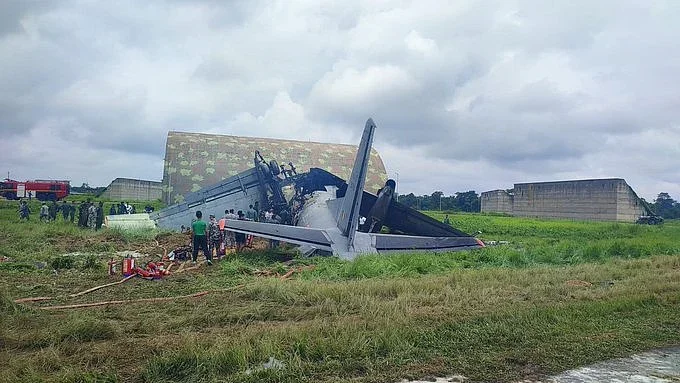
The Indian Air Force lost five of its personnel on Saturday morning when a Russian-origin An-32 transport aircraft crashed at the Air Force Station in Jorhat, Assam. The aircraft was on a routine operational sortie when the accident occurred around 10 am, sending shockwaves through the military community and the nation.
What happened at Jorhat Air Force Station
The An-32 aircraft, a twin-engine turboprop transport plane, met with an accident during what the IAF described as a routine operational sortie. The crash site was within the Air Force Station premises in Jorhat, a key military hub in northeastern India. The IAF confirmed that five personnel were on board and all lost their lives. Local authorities and IAF teams responded immediately to the scene.
Who were the five IAF personnel killed
The IAF identified the deceased as Squadron Leader Prashant Singh, Flight Lieutenant Shubham Kumar, Sergeant Jitendra Sharma, Agniveer Vayu Khemaram Kumawat, and Agniveer Vayu Danish Alam. The inclusion of two Agniveer Vayu personnel — part of the Agnipath scheme introduced in 2022 — highlights that even young recruits are exposed to high-risk operational duties. The loss has left families and colleagues in mourning.
Why this crash matters for India's military aviation
The An-32 fleet has been a workhorse of the IAF for decades, primarily used for transport and logistics in challenging terrains like the Northeast and high-altitude regions. However, the aircraft is aging — the first An-32s entered service in the 1980s. Saturday's crash is the latest in a series of accidents involving the type, raising concerns about fleet reliability and maintenance protocols. For the families of the deceased, the loss is personal and devastating.
Official response from the Indian Air Force
The IAF issued a statement expressing deep regret over the loss of personnel. "The Indian Air Force deeply regrets the loss of five personnel in the An-32 accident at Jorhat," the statement read. The Air Force said it stood firmly with the bereaved families during this time of grief. No further details about the cause of the crash were immediately released, pending investigation.
What is the An-32 aircraft and its history with the IAF
The Antonov An-32 is a Soviet-origin twin-engine turboprop transport aircraft, designed in the 1970s and first flown in 1976. The IAF operates a significant number of these aircraft, which have been upgraded over the years with modern avionics and engines under a deal with Ukraine. Despite upgrades, the fleet has experienced multiple accidents. In 2019, an An-32 went missing over the Bay of Bengal with 13 personnel on board, and wreckage was never found. Saturday's crash adds to a troubling pattern.
Confirmed facts vs what remains unclear
Confirmed: Five IAF personnel died in the crash. The aircraft was an An-32 on a routine operational sortie. The accident occurred at Jorhat Air Force Station around 10 am. The IAF has identified the deceased and expressed condolences. Unclear: The exact cause of the crash — whether mechanical failure, human error, or external factors. Whether the aircraft had any prior technical issues. The status of the flight data recorder or cockpit voice recorder recovery. Any potential grounding of the An-32 fleet pending investigation.
Risks and concerns around aging aircraft fleets
Military aviation experts have long flagged the risks of operating aging platforms like the An-32 without comprehensive modernization. While the IAF has undertaken upgrade programs, the age of the airframes remains a concern. Critics argue that the pace of replacement with newer aircraft like the C-130J or C-295 has been slow. However, the IAF maintains that its maintenance protocols are rigorous and that the An-32 remains operationally viable. Saturday's crash will likely intensify the debate over fleet renewal priorities.
Wider pattern of IAF transport aircraft accidents
The An-32 crash is not an isolated incident. The IAF has seen several accidents involving transport aircraft in recent years, including the 2019 An-32 disappearance and a 2021 Mi-17 helicopter crash that killed Chief of Defence Staff General Bipin Rawat. These incidents underscore the inherent risks of military aviation, especially in challenging operational environments like the Northeast, where weather and terrain add complexity.
What happens next for the IAF and the An-32 fleet
The IAF will likely order a Court of Inquiry to investigate the crash. The findings could take weeks or months. Depending on the outcome, the IAF may temporarily ground the An-32 fleet for safety checks, as has happened after previous accidents. For the families of the deceased, the immediate priority is support and closure. For the nation, the crash is a somber reminder of the sacrifices made by military personnel in routine duties that can turn tragic in an instant.
Our Take
Saturday's crash is a tragedy that cuts deep — not just for the IAF but for a nation that looks to its armed forces as a source of pride and security. The loss of five lives in a routine sortie underscores that there is no such thing as a "safe" military operation. Every flight carries risk. While investigations will determine the technical cause, the broader question is whether India is doing enough to modernize its aging transport fleet. The An-32 has served the IAF well, but the clock is ticking. For now, the focus must remain on the families of Squadron Leader Prashant Singh, Flight Lieutenant Shubham Kumar, Sergeant Jitendra Sharma, Agniveer Vayu Khemaram Kumawat, and Agniveer Vayu Danish Alam. Their loss is the nation's loss.
Frequently Asked Questions
What caused the IAF An-32 crash in Assam?
The exact cause is not yet known. The Indian Air Force has initiated a Court of Inquiry to investigate the accident. Possible factors include mechanical failure, human error, or environmental conditions, but nothing has been confirmed.
How many people died in the Jorhat air crash?
Five Indian Air Force personnel were killed. They have been identified as Squadron Leader Prashant Singh, Flight Lieutenant Shubham Kumar, Sergeant Jitendra Sharma, Agniveer Vayu Khemaram Kumawat, and Agniveer Vayu Danish Alam.
Is the An-32 aircraft safe to fly?
The An-32 has been a reliable transport aircraft for the IAF for decades, with upgrades to avionics and engines. However, like all aging aircraft, it faces increased maintenance challenges. The IAF maintains rigorous safety protocols, but accidents have occurred. The crash will prompt a review of the fleet's operational status.
What is the Agnipath scheme and how does it relate to this crash?
The Agnipath scheme, introduced in 2022, recruits young Indians as Agniveers for a four-year tenure in the armed forces. Two of the deceased — Agniveer Vayu Khemaram Kumawat and Agniveer Vayu Danish Alam — were Agniveers, highlighting that even short-service personnel are deployed in high-risk operational roles.