

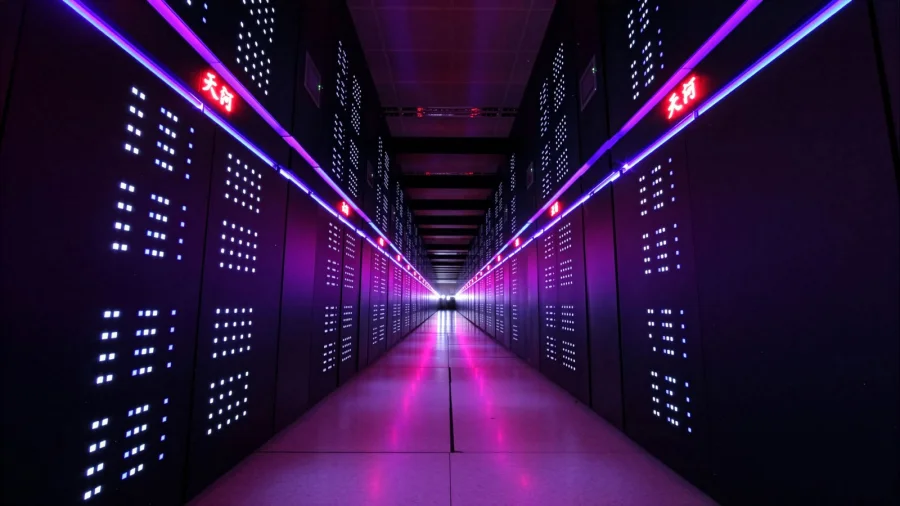
China has quietly reclaimed the top spot in the world’s most prestigious supercomputer ranking, and it did so with a move that surprised many in the industry. The new system, built entirely around central processing units (CPUs) rather than the graphics processing units (GPUs) favored by its rivals, signals a deliberate strategic shift — one that could reshape the global race for computing dominance.
How China’s CPU-powered supercomputer beat the GPU giants
The latest Top500 list, released at the International Supercomputing Conference in Frankfurt, places China’s new-generation machine at No.1. Unlike the US Frontier system at Oak Ridge National Laboratory, which relies on AMD GPUs, or Japan’s Fugaku, which uses ARM-based CPUs, China’s system uses domestically designed CPUs. This architectural choice is not just about performance — it reflects a broader push for technological self-sufficiency.
Why this matters beyond the ranking
For years, supercomputing has been dominated by systems that pair CPUs with thousands of GPUs to accelerate calculations, especially for AI workloads. China’s decision to go CPU-only challenges that orthodoxy. It suggests that Beijing is betting on a different path — one that prioritizes control over the entire supply chain. With US export restrictions limiting access to advanced GPUs from Nvidia and AMD, China’s CPU-only approach may be as much about necessity as strategy.
The road to the top: A timeline of China’s supercomputer rise
China first claimed the No.1 spot in 2010 with the Tianhe-1A system, which used a hybrid CPU-GPU architecture. It held the lead again in 2013 with Tianhe-2, which remained the fastest for years. But by 2018, the US regained the top spot with Summit, followed by Frontier in 2022. Now, with its latest CPU-only machine, China has returned to the summit — this time on its own terms.
Who benefits from a CPU-only supercomputer?
For Chinese researchers, the new system means faster simulations for climate modeling, drug discovery, and materials science — without relying on foreign chips. For the broader tech ecosystem, it signals that domestic chip design has matured enough to compete at the highest level. But the impact goes beyond labs: it could accelerate China’s ambitions in AI, where supercomputing is essential for training large models.
What officials and experts are saying
Officials at the National Supercomputing Center in Tianjin confirmed the achievement, emphasizing the system’s energy efficiency. “This is not just about speed,” a center representative said. “It’s about building a sustainable, independent computing ecosystem.” Industry analysts note that the CPU-only design may also reduce power consumption, a growing concern for large-scale data centers.
Why China chose CPUs over GPUs — the deeper story
The decision to use CPUs exclusively is rooted in China’s experience with US export controls. Since 2020, Washington has tightened restrictions on advanced semiconductor exports, including GPUs used in supercomputing. By designing a system that relies entirely on domestic CPUs, China sidesteps those restrictions entirely. It also sends a message: that China can compete at the frontier of computing without access to Western technology.
Confirmed facts vs what remains unclear
What is confirmed: China’s new system tops the latest Top500 list, uses CPUs only, and was developed domestically. What remains unclear: the exact performance figures, the specific chip architecture, and whether the system can sustain its lead in future rankings. Some details have not been publicly disclosed, likely due to national security concerns.
China’s supercomputer moat: Domestic chips and strategic independence
China’s advantage in supercomputing is not just about raw speed — it’s about control. By designing its own CPUs, China reduces dependence on foreign suppliers, insulates itself from export controls, and builds a domestic ecosystem of chip design, manufacturing, and software optimization. This moat is hard to replicate quickly, especially for countries that rely on imported GPUs.
Risks and balanced view
Not everyone is convinced that a CPU-only approach is sustainable. Critics argue that GPUs offer superior performance for AI workloads, which are increasingly central to supercomputing. Some experts warn that China’s domestic chips may still lag behind the latest Western designs in terms of raw performance per watt. There is also the risk that the ranking itself may not fully capture real-world application performance.
A broader trend: The global supercomputing race heats up
China’s return to the top is part of a larger pattern. The US, Japan, and Europe are all investing heavily in exascale computing — systems capable of performing a billion billion calculations per second. The competition is no longer just about speed; it’s about who controls the underlying technology. China’s CPU-only system is a reminder that the race is as much about geopolitics as it is about science.
What this means for students, researchers, and investors
For students and researchers, this development underscores the importance of understanding both hardware and software in high-performance computing. For investors, it highlights the growing value of domestic chip companies in China. For anyone following tech geopolitics, it’s a clear signal that the US-China technology rivalry is deepening — and supercomputing is at the center of it.
What happens next in the supercomputer race
China is expected to continue investing in domestic chip production, with plans for even more powerful systems in the coming years. The US, meanwhile, is pushing ahead with its own exascale machines, including El Capitan at Lawrence Livermore National Laboratory. The next Top500 list, due in six months, will show whether China can hold its lead — or whether the US will strike back.
Our Take
China’s CPU-only supercomputer is more than a technical achievement — it’s a strategic statement. By reclaiming the top spot without relying on foreign GPUs, Beijing has demonstrated that it can compete at the highest level of computing on its own terms. This is not just about a ranking; it’s about the future of technological sovereignty. The real story is not that China won — it’s how they chose to win.
Frequently Asked Questions
What is the Top500 supercomputer ranking?
The Top500 is a semiannual list of the world’s most powerful supercomputers, ranked by their performance on the LINPACK benchmark. It is widely considered the gold standard for measuring high-performance computing capability.
Why did China choose CPUs over GPUs for its new supercomputer?
China’s decision to use CPUs exclusively is driven by both strategy and necessity. US export controls restrict access to advanced GPUs from Nvidia and AMD, so China designed a system using domestically produced CPUs to maintain independence and control over its supply chain.
How does a CPU-only supercomputer compare to GPU-based systems?
CPU-only systems can be more energy-efficient and easier to program for certain workloads, but they may lag behind GPU-based systems in AI and machine learning tasks, where GPUs excel at parallel processing. The trade-off depends on the specific applications.
What does this mean for the US-China technology rivalry?
China’s return to the top of the supercomputer ranking signals that US export controls have not stopped China’s progress. It also suggests that the rivalry will intensify, with both nations investing heavily in domestic chip design and high-performance computing infrastructure.