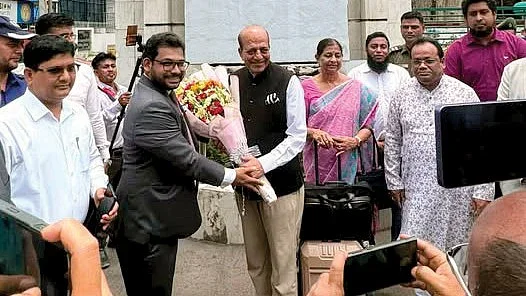
When India’s high commissioner to Bangladesh chose to walk across the international border at Petrapole-Benapole instead of taking a 45-minute flight, it was meant to be a gesture of warmth. Dinesh Trivedi’s road journey from Kolkata to Dhaka on 12 June — crossing the newly-built Padma bridge — was welcomed in Dhaka as a signal of connectivity and goodwill. But even as Trivedi spoke of not feeling like a foreigner in Bangladesh, a separate incident at Delhi airport told a different story about the state of bilateral ties.
Why Trivedi’s road trip matters for India-Bangladesh relations
Trivedi’s decision to travel by road was not logistical — it was diplomatic. The 45-minute flight is the norm. Walking across the border and driving over the Padma bridge, a project financed by Bangladesh itself, sent a message of shared infrastructure and people-to-people ties. In Dhaka, Trivedi recounted his journey with enthusiasm: “Upon entering Bangladesh, I did not feel like a foreigner. India and Bangladesh are strong democracies. Whatever we do, we have to do it together. We cannot be powerful in isolation.” The optics were carefully calibrated, especially given how delicately poised relations currently are.
The Delhi airport hold-up that soured the mood
But the warmth in Dhaka was undercut by reports that a Bangladesh PM’s adviser was held up at Delhi airport. According to The Wire, the incident required an “instant protest” from Dhaka, reflecting the strain in diplomatic relations. The hold-up — reportedly over security or protocol issues — was seen in Bangladesh as a lack of respect, especially when contrasted with the red carpet welcome given to Bangladesh PM Sheikh Hasina during her visit to New Delhi for the G-20 summit in September 2023. The Business Standard had reported then that Hasina received a “red carpet welcome” on arrival. The contrast between that welcome and the adviser’s hold-up now highlights how quickly the mood can shift.
Border tensions and alleged push-ins: The real friction point
The hold-up at Delhi airport did not happen in a vacuum. Behind the diplomatic gestures lies a deeper friction over border security. Bangladesh has raised concerns about alleged push-ins by Indian authorities — where individuals are forcibly sent back across the border without due process. These allegations have strained ties, with Dhaka demanding clearer protocols and accountability. The hold-up of the PM’s adviser, though a separate incident, was seen in Dhaka as part of a pattern of disregard. As one South Asia watcher noted, the road trip was a welcome signal, but the airport incident reminded everyone that trust remains fragile.
What the two signals say about the relationship
Trivedi’s journey and the airport hold-up represent the two faces of India-Bangladesh relations right now. On one hand, there is a genuine desire to deepen connectivity — the Padma bridge, the road link, the shared democratic values. On the other hand, there are unresolved grievances over border management, security protocols, and diplomatic courtesy. The contrast is not lost on either side. In Dhaka, Trivedi’s words were appreciated. But in Delhi, the hold-up raised questions about whether the warmth is being reciprocated at the operational level.
Official responses: What has been said so far
Trivedi’s remarks in Dhaka have been widely reported. He emphasized the need for India and Bangladesh to work together, saying, “We cannot be powerful in isolation.” On the airport hold-up, Bangladesh’s PM adviser called for an “instant protest,” according to The Wire. The Indian side has not issued a detailed public response on the hold-up, but the incident has been noted in diplomatic circles. The contrast between the high commissioner’s warm words and the adviser’s treatment underscores the gap between intent and execution.
Why this matters for the 160 crore people of both countries
Trivedi himself hinted at the stakes: “Imagine the enormous economic possibilities if the 160 crore people of both countries combine resources.” The potential for trade, energy, and connectivity is immense. But such potential requires trust. Every hold-up — literal or diplomatic — erodes that trust. For ordinary citizens on both sides, the relationship affects everything from border trade to travel to cultural exchange. The road trip was a reminder of what is possible. The airport incident was a reminder of what still needs to be fixed.
Confirmed facts vs what remains unclear
Confirmed: Dinesh Trivedi travelled from Kolkata to Dhaka by road on 12 June, walking across the Petrapole-Benapole border and crossing the Padma bridge. Confirmed: Trivedi made positive remarks about India-Bangladesh ties in Dhaka. Confirmed: A Bangladesh PM’s adviser was reportedly held up at Delhi airport, prompting a protest from Dhaka. Unclear: The exact reason for the hold-up — whether it was a security protocol issue, a miscommunication, or something else. Unclear: Whether the Indian government has formally responded to the protest. The airport incident has been reported by The Wire and MSN, but official details remain sparse.
Risks and balanced view: The fragility of diplomatic gestures
While Trivedi’s road trip was a positive gesture, it cannot paper over the underlying tensions. Border security concerns, alleged push-ins, and diplomatic protocol issues remain unresolved. Supporters of the road trip argue it signals a new chapter of connectivity. Critics say gestures alone are not enough — they need to be backed by policy changes and consistent behaviour. The airport hold-up, whether a minor protocol lapse or a more significant slight, shows how quickly goodwill can be undermined. Both sides need to address the root causes of friction, not just the optics.
Wider pattern: India’s neighbourhood diplomacy under strain
The India-Bangladesh dynamic is part of a broader pattern in India’s neighbourhood policy. While India has made efforts to strengthen ties with Bangladesh, Nepal, and Sri Lanka through connectivity projects and infrastructure, diplomatic incidents — from airport hold-ups to border skirmishes — often create setbacks. The challenge for New Delhi is to ensure that its gestures of goodwill are matched by consistent, respectful treatment of its neighbours at every level. The Trivedi road trip was a step in the right direction. The airport incident was a step back.
Practical guidance: What should citizens and observers watch for
For those following India-Bangladesh relations, the key indicators to watch are: (1) Whether India issues a formal clarification or apology for the airport hold-up; (2) Whether Bangladesh’s PM Sheikh Hasina raises the issue in any upcoming bilateral meeting; (3) Whether border security protocols are reviewed to prevent future push-in allegations; (4) Whether more high-level visits and gestures follow Trivedi’s road trip. For travellers and businesses, the relationship’s stability affects visa processing, trade routes, and cross-border movement. Any escalation could have practical consequences.
Future outlook: Can the warmth survive the hold-up?
The immediate future depends on how both sides handle the fallout. If the airport incident is resolved quickly with a diplomatic apology or clarification, the positive signal from Trivedi’s road trip may still carry weight. But if the hold-up becomes a recurring grievance, it could deepen mistrust. The Padma bridge and the road link are symbols of what is possible. But symbols need substance. The next few weeks will show whether the warmth in Dhaka or the hold-up in Delhi defines the next chapter of India-Bangladesh relations.
Our Take
The Trivedi road trip was a smart diplomatic move — it humanized the relationship and emphasized shared geography and democratic values. But diplomacy is not just about grand gestures. It is also about how a visiting adviser is treated at an airport. The hold-up in Delhi, whether a minor protocol error or a more deliberate slight, risks undoing the goodwill generated by the road journey. India and Bangladesh have too much at stake — 160 crore people, shared borders, and enormous economic potential — to let such incidents fester. Both sides need to move beyond optics and address the operational realities that create friction. The road trip was a welcome start. But the journey is far from over.
Frequently Asked Questions
Why did Dinesh Trivedi travel by road from Kolkata to Dhaka?
Trivedi, India’s high commissioner to Bangladesh, chose to travel by road instead of the usual 45-minute flight as a deliberate diplomatic gesture to signal warmth, connectivity, and shared infrastructure between the two countries.
What happened at Delhi airport involving a Bangladesh PM adviser?
A Bangladesh PM’s adviser was reportedly held up at Delhi airport, prompting Dhaka to call for an “instant protest.” The exact reason for the hold-up remains unclear, but it has been seen as a sign of diplomatic strain.
How does the airport hold-up affect India-Bangladesh relations?
The hold-up undercuts the positive signal sent by Trivedi’s road trip. It highlights unresolved tensions over border security, diplomatic protocols, and mutual respect, making the relationship appear fragile despite gestures of goodwill.
What is the significance of the Padma bridge in this context?
The Padma bridge, financed by Bangladesh itself, is a symbol of Bangladesh’s infrastructure ambition. Trivedi driving over it was seen as a recognition of Bangladesh’s achievements and a signal of shared connectivity goals.