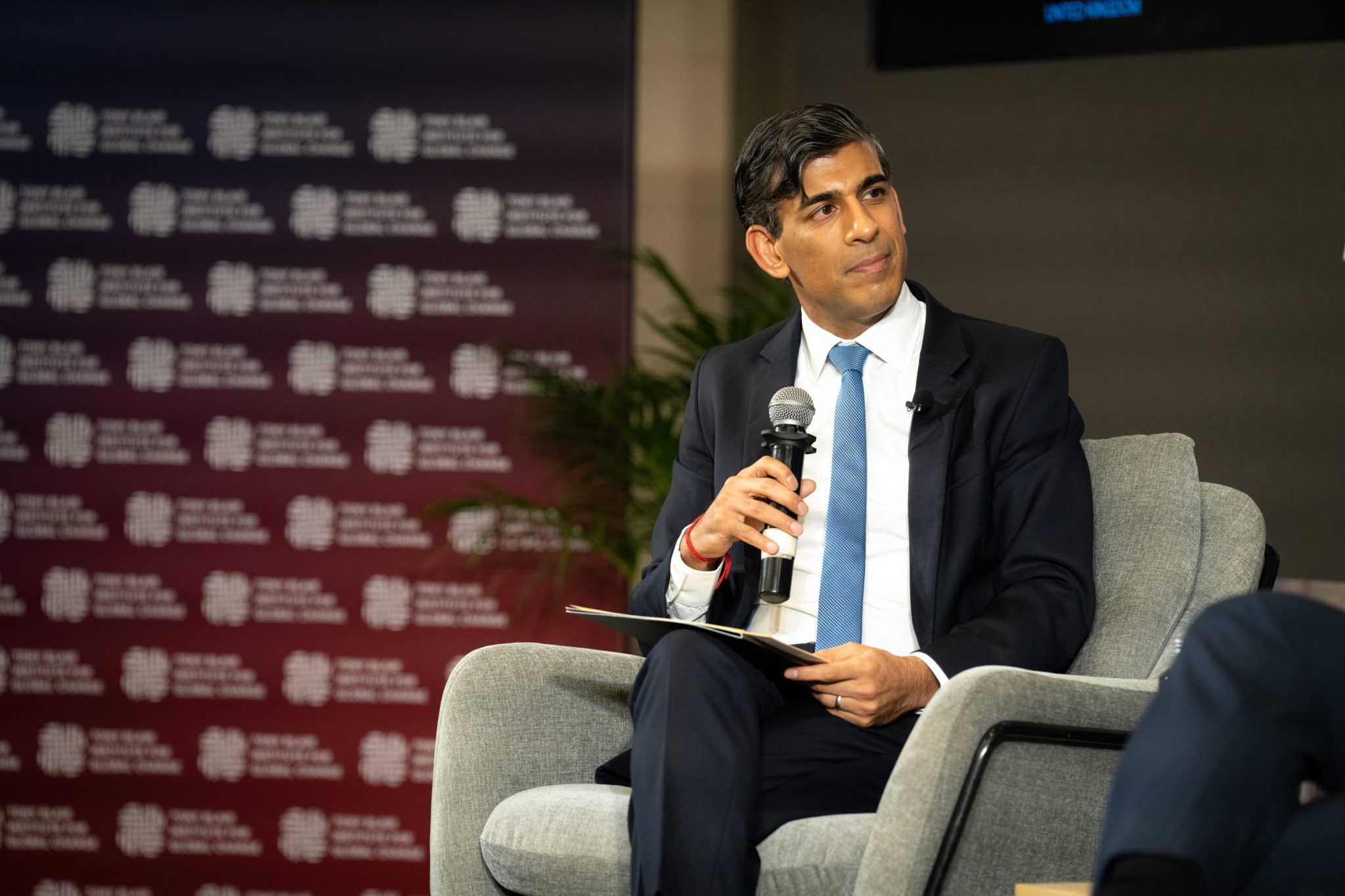
Former UK Prime Minister Rishi Sunak warned business leaders in Birmingham on March 26, 2026, that failing to adopt artificial intelligence at speed will leave companies on the losing side of a "K-shaped" economy. Sunak told an audience of hundreds that businesses must prioritize practical needs over technology for its own sake to avoid drifting backward.
Sunak outlines three golden rules for AI adoption in Birmingham
Rishi Sunak delivered a strategy for artificial intelligence (AI) integration during a meeting with hundreds of small business owners in England’s second-largest city. According to Kamal Ahmed, Fortune’s executive editorial director for Europe, Sunak presented three specific "golden rules" for leaders to follow. First, he told CEOs to identify specific business needs before choosing a technology. Second, he urged them to make decisions quickly to avoid falling behind competitors. Third, he advised companies to "pilot and iterate" rather than attempting to overhaul an entire organization at once.
Sunak argued that smaller businesses are better positioned to lead this transition because they lack the heavy bureaucracy of larger corporations. This agility allows them to test new tools and change direction faster than global firms. By focusing on small, manageable projects, these companies can find what works without risking their entire operation on a single unproven system.
The former prime minister also highlighted that AI adoption is no longer optional for those who want to grow. He described a "K-shaped" economic future where companies that use AI move upward in productivity and value, while those that wait begin a steady decline. This means the gap between tech-ready firms and laggards will likely widen significantly in the coming months.
From Downing Street to Silicon Valley advisor
Rishi Sunak served as the UK Prime Minister from 2022 until his election defeat in 2024 by Keir Starmer. Despite the change in government, Sunak remains a central figure in the UK’s technology policy landscape. He holds an MBA from Stanford University and currently serves as an advisor to major global entities, including Goldman Sachs, Microsoft, and the AI firm Anthropic. His background in both high finance and Silicon Valley culture makes him a bridge between UK policy and US tech momentum.
The current Labour government under Keir Starmer maintains a surprisingly close relationship with Sunak on the topic of AI development. The UK business department regularly contacts the former prime minister for advice on how to accelerate tech growth. This cross-party alignment suggests that the UK's push for rapid AI adoption is a long-term national strategy rather than a temporary political trend. Both leaders agree that the country must move faster to compete with the US and China.
Why small business leaders face the biggest AI opportunity
The real-world effect of this AI shift is most visible among small and medium-sized enterprises (SMEs). Sunak noted that these businesses employ the majority of the workforce and are often more "nimble" than large-scale bureaucracies. For a small business owner, adopting a new AI tool for customer service or inventory management can happen in weeks, whereas a global corporation might take years to clear the same change through legal and IT departments.
However, these leaders also face the highest risk of being left behind if they do not act. In a K-shaped economy, the "laggards" are often smaller firms that lack the capital or the technical confidence to start. Sunak’s message was designed to reassure these owners that they do not need to "boil the ocean" or spend millions to start seeing benefits. The consequence of inaction is a loss of competitiveness that could eventually lead to business failure as AI-driven rivals lower their costs.
The shift from massive projects to iterative AI piloting
The practical approach to AI is changing from large-scale implementation to a "pilot and iterate" model. Instead of buying expensive, all-in-one software packages, businesses are now encouraged to test specific AI functions in small departments. This change reduces the financial risk and allows staff to learn the technology in stages. If a pilot project fails, the company can pivot quickly without having wasted significant resources.
This ground-level change involves several key steps for CEOs:
- Identifying a single, repetitive task that AI can automate today.
- Running a short-term test with a small team to measure time savings.
- Gathering feedback from employees to ensure the tool actually helps their workflow.
- Expanding the use of the tool only after it proves its value in the pilot phase.
By following this path, businesses can build technical confidence without the fear of a total system failure. This method also helps address the "false confidence" risk, where leaders trust AI outputs too much without verifying them against their own business knowledge.
How the K-shaped economy creates winners and laggards
The "K-shaped" economy is a concept where different parts of the economy move in opposite directions after a major disruption. In the context of AI, the upward arm of the "K" represents companies that use technology to increase their efficiency and reach more customers. The downward arm represents businesses that continue using traditional methods, finding themselves unable to match the speed or pricing of their tech-enabled competitors. This creates a permanent divide in the market.
A major risk in this transition is what business leaders call "false confidence." Tools like Google’s Gemini, Anthropic’s Claude, and Perplexity can provide slick, professional-sounding answers in seconds. However, these answers are not always accurate or relevant to a specific company’s needs. The risk is that a CEO might follow AI advice that sounds plausible but lacks a deep understanding of their specific customer base. To manage this, Sunak argues that human judgment must remain the final filter for any AI-generated strategy.
Continued cooperation between Sunak and the UK business department
The UK government is expected to continue its consultation with Rishi Sunak as it develops new AI regulations and growth incentives. While Sunak is no longer in office, his roles at Microsoft and Anthropic provide him with direct insight into the next wave of technology. The UK business department seeks to use this expertise to ensure that local regulations do not stifle innovation. This ongoing dialogue suggests that the UK will remain a "pro-innovation" environment for the foreseeable future.
Further events for business leaders are expected throughout 2026 to help bridge the gap between tech developers and traditional industries. The goal is to ensure that the UK's high-value tech firms, such as the $75 billion fintech giant Revolut, can support a wider ecosystem of smaller businesses. No specific dates for new legislation have been confirmed, but the focus remains on speed and market readiness.
Key Numbers and Facts
The confirmed figures behind this story at a glance.
Key Fact Detail Main person Rishi Sunak, Former UK Prime Minister Current advisory roles Goldman Sachs, Microsoft, Anthropic Date of Birmingham event March 26, 2026 Location Birmingham, United Kingdom Valuation of Revolut $75 billion Valuation of Nscale $14.6 billion Current UK Prime Minister Keir Starmer Primary economic risk K-shaped economy (split between winners and laggards) Next confirmed step Continued consultation with UK business department
Why business logic must lead the AI transition
The most important takeaway from Sunak’s Birmingham address is that AI is a business tool, not a magic solution. Leaders who chase the newest technology without a clear plan for their customers risk wasting time and money. The real winners in the coming years will be those who combine human expertise with the speed of AI, using the technology to solve existing problems rather than creating new ones. Speed is essential, but it must be guided by a firm understanding of a company’s core value.
Frequently Asked Questions
What is a K-shaped economy in the context of AI?
A K-shaped economy describes a situation where one group of businesses grows rapidly while another group declines. In this scenario, companies that adopt AI effectively move upward, while those that fail to adapt lose their competitive edge and drift backward. This creates a sharp divide in the market between tech-enabled winners and traditional laggards.
What are Rishi Sunak's three rules for AI?
Sunak's three rules are to put business needs before technology, make decisions at high speed, and use an iterative "pilot" approach. He advises CEOs to identify a problem first, then find the AI tool that solves it, rather than the other way around. He also warns against trying to change everything at once, suggesting small, manageable tests instead.
How can small businesses compete with large corporations in AI?
Small businesses can compete by using their agility to test and implement new tools faster than large, bureaucratic companies. Because they have fewer layers of management, they can pilot AI projects and pivot based on results in a fraction of the time it takes a global firm. This speed allows them to find efficient solutions and lower their costs more quickly.