

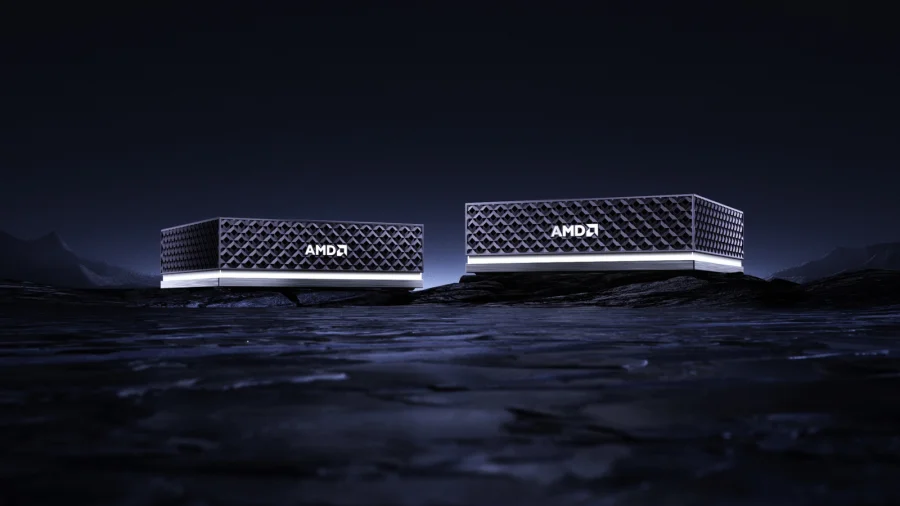
The AI hardware war just got a lot more interesting. AMD has officially priced its new Ryzen AI Halo mini-PC at $3,999, and it's not just another computer — it's a direct, calculated shot at NVIDIA's DGX Spark. For developers, researchers, and AI enthusiasts who have been watching the battle for desktop AI supremacy, this is the moment the playing field shifts.
AMD's $3,999 Answer to NVIDIA's AI Dominance
AMD is making no secret of its intentions. The Ryzen AI Halo PC is built from the ground up to deliver desktop-class AI compute in a compact form factor. Priced at $3,999, it undercuts some high-end AI workstations while offering integrated graphics and unified memory architecture that AMD claims is ideal for running large language models and AI inference tasks locally.
According to reports, the system is powered by the new Ryzen AI Max+ processor, which combines Zen 5 CPU cores with RDNA 3.5 graphics and a dedicated AI engine. This isn't a gaming PC dressed up for AI — it's a purpose-built machine for developers who need to train, test, and deploy models without relying on cloud services.
Why This Matters Right Now
The timing couldn't be more critical. As AI models grow larger and more complex, developers are increasingly looking for powerful local hardware to prototype and run models without expensive cloud GPU rentals. NVIDIA's DGX Spark has been the go-to choice for many, but at a similar price point, AMD is offering an alternative that could shake up the market.
For individual developers, startups, and even academic researchers, a $3,999 price tag for a dedicated AI mini-PC is significant. It brings enterprise-level AI compute within reach of smaller teams and independent innovators. The emotional weight here is about access — AMD is betting that developers want choice, and they want it without being locked into one ecosystem.
How the Announcement Unfolded
AMD revealed the pricing and the new Ryzen AI Max 400 chips during a recent event, positioning the Halo PC as a "developer-first" device. The company emphasized its unified memory architecture, which allows the CPU and GPU to share a single pool of high-bandwidth memory — a critical feature for AI workloads that require large datasets to be processed without bottlenecks.
The Ryzen AI Max 400 series, codenamed "Gorgon Halo," is a refreshed APU lineup that supports up to 192GB of unified memory and can clock up to 5.2 GHz. This is a massive leap in capability for an integrated solution, and it directly challenges NVIDIA's approach of using discrete GPUs for AI tasks.
Who Is Affected and What AMD Is Saying
The primary audience is clear: AI developers, machine learning engineers, and tech enthusiasts who want to run models locally. But the ripple effects extend to the broader PC industry. AMD is signaling that it's serious about AI hardware, not just in data centers but on the desktop.
AMD officials have positioned the Ryzen AI Halo as a tool for "democratizing AI development." While the company hasn't released official performance benchmarks against the DGX Spark, early reports suggest the Halo PC can handle models like Llama 2 and Mistral with impressive efficiency, thanks to its unified memory and high-bandwidth architecture.
What We Know So Far — and What Remains Unclear
What we know:
- The Ryzen AI Halo PC is priced at $3,999.
- It uses the Ryzen AI Max+ processor with Zen 5 and RDNA 3.5.
- Pre-orders are expected to open in June 2026.
- It supports up to 128GB of unified memory in the base configuration.
What remains unclear:
- Exact performance comparisons against NVIDIA's DGX Spark in real-world AI workloads.
- Availability outside the US and specific pre-order dates.
- Whether AMD will offer lower-cost configurations or only the $3,999 model.
- Long-term software ecosystem support and developer tool compatibility.
Risks, Concerns, and the Balanced View
While the Ryzen AI Halo PC looks promising on paper, there are legitimate concerns. NVIDIA's CUDA ecosystem remains the gold standard for AI development, with a massive library of optimized libraries and tools. AMD's ROCm software stack has improved significantly, but it still lags behind in terms of community support and third-party integration.
Another risk is the price. At $3,999, the Halo PC is not cheap. While it undercuts some workstations, it's still a significant investment for individual developers. If AMD cannot deliver on performance promises or if software compatibility issues arise, early adopters could be left with an expensive paperweight.
There's also the question of longevity. AI hardware evolves rapidly, and a $3,999 investment today could feel outdated in 18 months. AMD will need to demonstrate a clear upgrade path or long-term value to justify the cost.
Why Similar Trends Are Growing
The push for local AI compute is not new, but it's accelerating. Companies like Apple with its M-series chips, Intel with its AI accelerators, and now AMD are all racing to put powerful AI capabilities directly into users' hands. The reason is simple: latency, privacy, and cost. Running AI models locally eliminates the need to send data to the cloud, reduces latency for real-time applications, and cuts recurring cloud costs.
AMD's move is part of a broader trend where chipmakers are integrating AI engines directly into their processors, making AI compute accessible without requiring expensive discrete GPUs. The Ryzen AI Halo PC is the most aggressive example yet of this philosophy.
"Introducing AMD Ryzen AI Halo, a mini-PC powered by Ryzen AI Max+ that delivers desktop-class AI compute and integrated graphics for running large language models and AI inference tasks locally." — AMD official statement
What Developers and Investors Should Know Now
For developers, the key takeaway is that AMD is offering a viable alternative to NVIDIA for local AI development. If you're building applications that require on-device inference, the Ryzen AI Halo PC could be a compelling option — provided you're willing to navigate AMD's software ecosystem.
For investors, this announcement signals that AMD is serious about capturing a slice of the AI hardware market beyond data centers. The success of the Ryzen AI Halo PC will depend on developer adoption and real-world performance, but the strategic direction is clear.
What Could Happen Next
Expect NVIDIA to respond, either with a price cut on the DGX Spark or with a new product announcement. The AI hardware race is heating up, and competition is good for consumers. We may also see third-party manufacturers build their own mini-PCs around the Ryzen AI Max 400 chips, expanding the ecosystem.
Pre-orders in June will be the first real test of demand. If AMD can secure strong early adoption and positive reviews, the Ryzen AI Halo PC could become a staple in AI development labs worldwide.
Our Take: Why This Story Matters Beyond One Product
This isn't just about a single mini-PC. It's about the democratization of AI hardware. For years, NVIDIA has dominated the AI compute space, and any credible competition is a healthy development for the industry. AMD's Ryzen AI Halo PC represents a genuine attempt to break that monopoly, offering developers choice and potentially lower costs.
Whether it succeeds will depend on execution, but the ambition is undeniable. For anyone who believes that AI should be accessible to more people, not just those with deep pockets and NVIDIA GPUs, this is a story worth watching closely.
FAQs
What is the AMD Ryzen AI Halo PC price?
The AMD Ryzen AI Halo PC is priced at $3,999. It is a mini-PC designed for AI developers, featuring the Ryzen AI Max+ processor with unified memory architecture.
How does the Ryzen AI Halo PC compare to NVIDIA's DGX Spark?
Both are compact AI development systems priced around $4,000. The Ryzen AI Halo uses AMD's integrated APU with Zen 5 and RDNA 3.5, while the DGX Spark relies on NVIDIA's GPU ecosystem. Performance comparisons are not yet available, but the key difference is software ecosystem — NVIDIA's CUDA vs AMD's ROCm.
When can I pre-order the AMD Ryzen AI Halo PC?
Pre-orders for the AMD Ryzen AI Halo PC are expected to open in June 2026. Exact dates and regional availability have not been announced yet.
What are the key specs of the Ryzen AI Max 400 chips?
The Ryzen AI Max 400 series, codenamed "Gorgon Halo," features Zen 5 CPU cores, RDNA 3.5 integrated graphics, support for up to 192GB of unified memory, and clock speeds up to 5.2 GHz. It is designed for high-performance AI and graphics workloads in a compact form factor.